People possess worldviews or points or view. Worldviews are not static, yet they are not completely flexible. People are not born with these worldviews. They are learned and shaped by experiences.
Worldviews influence perception, which is the meaning people attach to experiences.
The world is perceived. Meaning is not objective, the same for all people. The meaning individuals attach to experiences can be tied to their worldviews.
Components of a World View
BASIC BELIEFS
Ethics- What should I do?
Epistemology- How do I know? (true vs false)
History- Where do I come from? How did we get to this point?
Future view- Where are we headed?
Beliefs- What do I value? How does the world work?
Social Institutions seek to shape worldviews: Family, Government, School, Media
Showing posts with label social constructs. Show all posts
Showing posts with label social constructs. Show all posts
Wednesday, July 16, 2014

Sunday, July 13, 2014
Class: One's Relative Position in Society
I am taking a closer look at a New York Times series on Class in the United States, published in 2005. In this overview of the series, the author talks about the invisible, or shadowy, lines that divide us. Depending on the place and time period, the dividing lines may be more or less visible. And the factors that divide may not always be the same.
I like the metaphors of invisible lines or shadows because it reminds me that we need to dig beneath the surface when thinking about the social world. Whether students are examining sources from the 16th century or the 21st century class is often a useful entry point.
Additionally, distinctions need to be made about the indicators, or markers, of class and the causes of class divisions. Markers of class include, or have typically included, the way a person dresses, what and where they eat, the kinds of cars they drive, the zip codes they live in, to name a few. Getting at the root causes of class divisions and the factors that maintain and perpetuate these divisions is a much larger, and worthwhile, undertaking.
The times series explores a number of the markers tied to class as well as the connections between class and access to education and health care.
Particularly puzzling, according to the authors, is the disconnect that appears to exist in the United States between perceptions of class and statistics about inequality. They seem to be moving in opposite directions. As the concentration of wealth intensifies, a reality which can traced back to the 1970s, attitudes about class and its perceived relevance seem to be diminishing.
As history students, it is important that we pay attention to the role that class plays in the sources that we examine. Sources come from people, and people have different points of view, which can often be tied to class differences, to a person’s position in society. Point of view analysis means you are attempting to identify and articulate key factors that may influence an author’s point of view.
Tuesday, July 8, 2014
Digging Deeper
Last night I found a website called Rhetorica that had a page dedicated to discussing media bias. Many of the core ideas on this page overlap with some of the big ideas I have been discussing about the discipline of history.
Specifically, I think, I can tie some of the points made on the Rhetorica page to some of my recent posts discussing social constructions, bias, and source work.
Whenever we give students sources- all sources not just primary sources- it is important for us to model and, ultimately, expect that students will conduct a point of view analysis to unlock meaning from these sources.
The first sentence on the Rhetorica page that I linked to above is this: There is no such thing as an objective point of view. This fact is fundamental to the discipline of history. The author of the Rhetorica page continues,
“No matter how much we may try to ignore it, human communication always takes place in a context, through a medium, and among individuals and groups who are situated historically, politically, economically, and socially. This state of affairs is neither bad nor good. It simply is. Bias is a small word that identifies the collective influences of the entire context of a message.”
When we give students sources, or when they find their own, they need to have an awareness of, or be helped to see, this fundamental, that there is no such thing as an objective, or neutral, point of view.

When we give students sources, we want them to think about what’s below the surface. But to do that, they must use what’s visible, and they must use their knowledge. This process is challenging because it is inference based.

Both of these images, the iceberg and the plant roots, help to illustrate visually that if students are only focused on what’s visible, often the words on the page, they are not focusing on what is beneath the surface. And it is what’s beneath the surface, where meaning making occurs.
Let’s turn our attention back to the source that I was looking at yesterday, Scheurl’s diary entry.
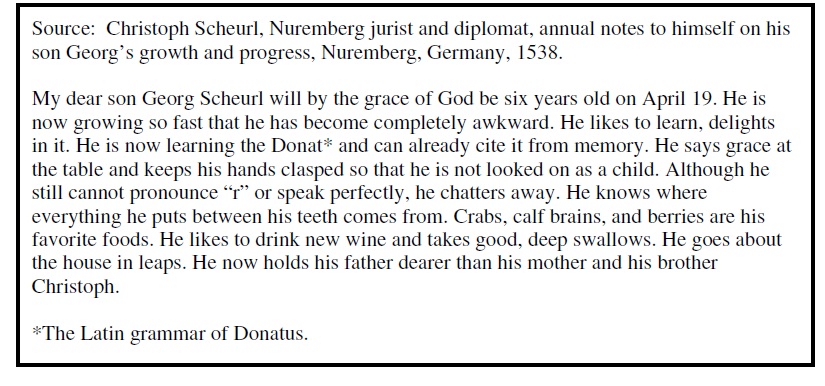
What are some ways to help students penetrate the superficial levels of this source? What are the roots, present but unseen, that underpin this source? Who is Chris Scheurl? How are we to make sense of this source?
Making sense of this source is about more than comprehending its message, though that is an essential part of the process.
We have to understand how this source might provide evidence for various assertions about the past.
Like the iceberg or the plant, we have to wonder about the origins of the source, what brought it into being.
My analysis of this source focused on the following ways it might be used as evidence, revealing to us details about
-the elite------------> Not everyone is society has the same opportunities. What opportunities did this child have?
-how children of the elite were raised
-a well situated father’s view of parenting
-the material wealth of those in the elite→ where they lived, how they lived, what they ate,
-conceptions of childhood. What does it mean to be a 5 or 6 year old, living in a prosperous home, in Nuremberg in 1538?
-the intellectual life of a well to do man living in Nuremberg in 1538. What were his private thoughts, hopes/dreams/fears?
-the role that writing played in this man’s life. How often did he journal? What did he focus on?
The above notes reveal, I think, the act of digging deeper, of not treating a source as a self evident statement of facts.
(Note: I spent as much time on this one source as students have to complete an entire AP Europ DBQ that includes a dozen sources!)
Monday, July 7, 2014
Social Constructs and Point of View Analysis, Part II
Yesterday, I started to discuss how applying the idea of social constructs can help to make source work more meaningful. Before attempting an example, I want to share an excerpt from a reading that I discovered yesterday.
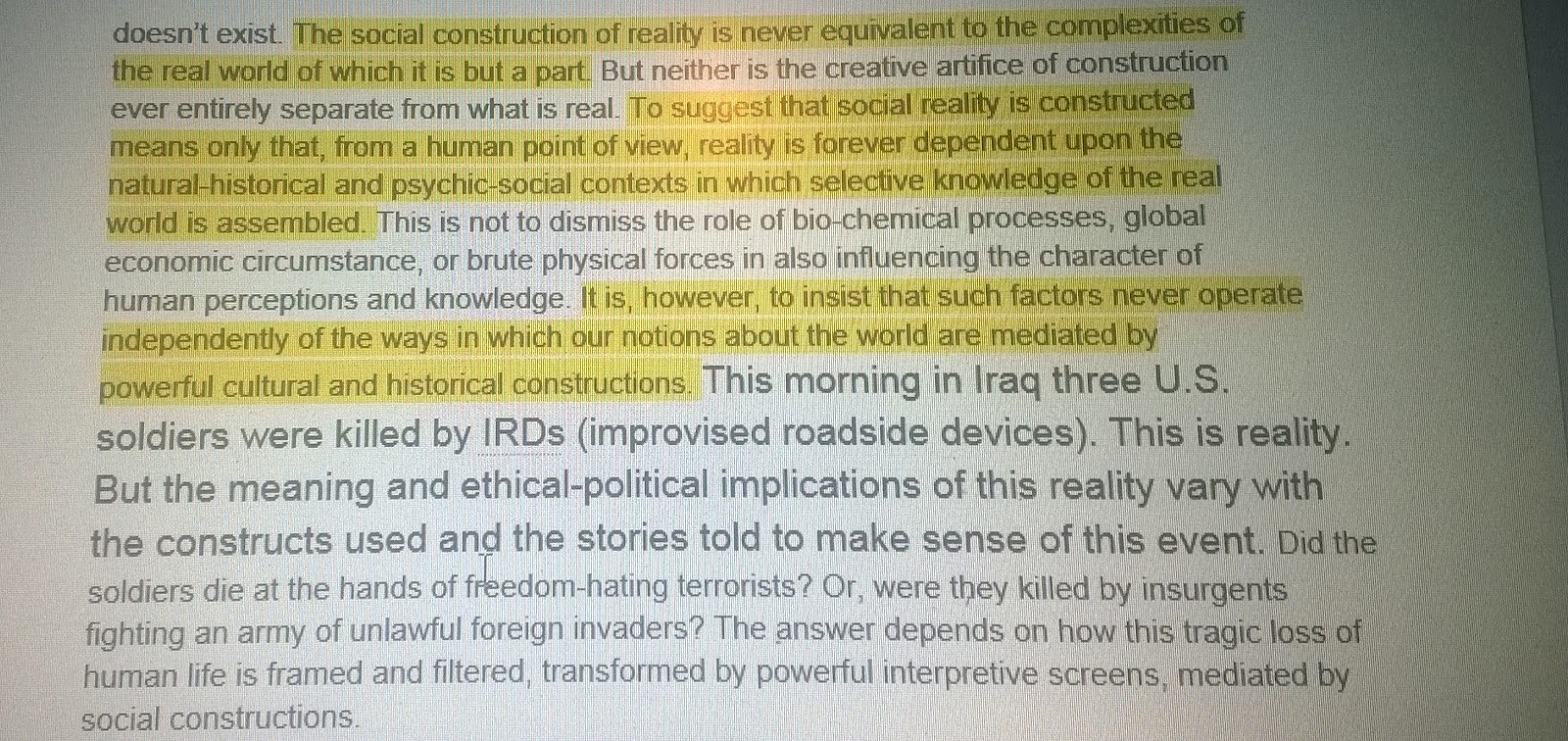
The text I linked to is long, and I have decided to read short sections each day rather than all at once. This section stands out because it links a number of concepts that I have been thinking about, as I explore the nature of perception, especially as it shapes sources and how historians derive meaning from sources. These concepts include: perception (social construction of reality), contexts, meaning, stories, frames and filters, interpretation.
Now, let’s turn our attention back to this source excerpt, which I found in a released AP Euro DBQ.
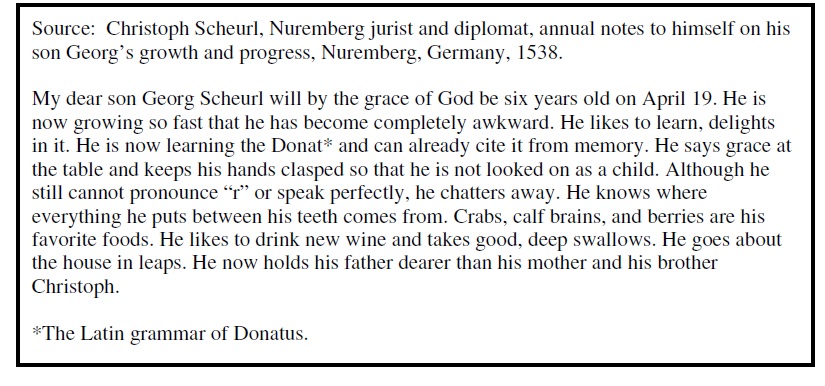
We want students to dig deeper, as opposed to simply reporting or restating the information contained in this source. How can we get them to do that? My thought is that if we have taught them about social construction theory, or at least some of its basic elements, they will have the tools to unlock the deeper meanings embedded in this source.
Where to begin?
They must begin by looking at the author and using the information provided to consider how that may shape the message contained in the source. Christop Scheurl, they are told, was a jurist and diplomat who lived in Nuremberg in 1538. What constructs can they apply to their point of view analysis?
Gender and social class are the two that seem obvious to me.
For what it’s worth, I found a resource (.doc file) yesterday where a teacher uses the following mnemonics (one basic, the other more detailed) to help students think about point of view (POV) analysis:
MAGS: Medium, Audience, Gender, Social Class
ACORNPEG: Audience, Class, Occupation, Religion, Nationality, Political Affiliation, Education, Gender
If we use social class to think about this source, what might that look like? The key question to ask, I think, is as follows: How might social class have influenced or shaped the information Scheurl reveals in his diary entry?
Stepping back for a moment, it is important for us to consider the prompt that this source is tied to.

Scheurl, a jurist and diplomat, was a privileged member of society. This opened doors for his children, providing them with comforts and opportunities that other children would not have automatically received. Scheurl’s diary reveals that his son was receiving a quality education. One that included instruction in Latin. The diary also provides evidence of how this family’s wealth impacted their diet when Scheurl discusses his son’s knowledge of “where everything he puts between his teeth comes from”, including berries, calf brains, crabs, and wine. Parents’ assumptions about their children were influenced by social class. In privileged families, access to education and food combined with parents’ lofty goals for their children to create a comfortable, nurturing environment. This diary entry provides us with a glimpse at how privilege tends to perpetuate privilege. This is revealed both materially and intellectually.
Sunday, July 6, 2014
Social Constructions and Source Work
This past week I have read and listened to Barbara J Fields (more Fields) and Judith Butler (more Butler) for the first time. Both names were suggested by David Salmanson in a blog post about theory for high school teachers.
The more I come to terms with the subjective nature of historical analysis, the more I have to inform myself about the structures that underpin historical narratives and the concepts and theories that have been advanced to help us to think about the various social constructs that influence our perceptions.
We know that students and many (?) teachers have a difficult time thinking about history as more than just facts about the past that are passed down from generation to generation. The more I read and think about various constructs, such as race, gender, notions of time, and religion, I realize that when I examine a source, one of my fundamental jobs is to look for evidence of these constructions, to define them and to place them into a larger context. For example, here is a source that I recently encountered when examining a released AP Euro DBQ:
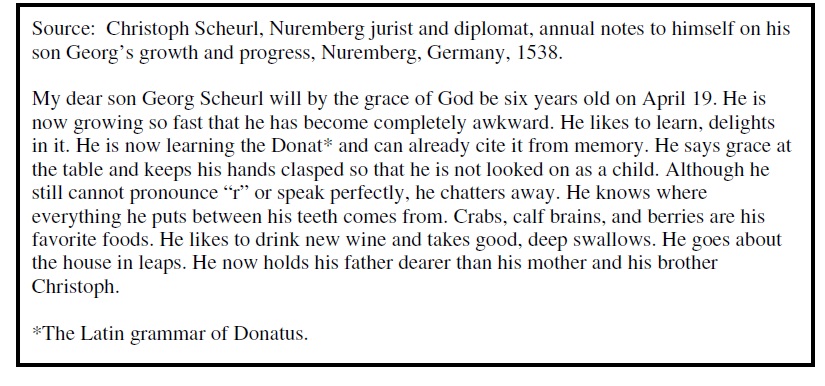
Before my knowledge about how historians do their job evolved, I would have looked at a source like this as a repository of facts that could be identified and remembered, adding to my store of knowledge about the past. We know that this is the way many students continue to view the discipline of history, even in classes where working with a variety of primary and secondary sources is emphasized.
Instead, a source like this needs to be examined from a variety of angles. It needs to be deconstructed, questioned, and ultimately, if it can be used to support a thesis, included in an interpretation about the past.
What I’d like to do over the next few days is to actually apply the ideas I have been discussing to this particular source.
More tomorrow...
Update
Update
Here are two additional resources that I think will help me dig deeper.
http://oyc.yale.edu/sociology/socy-151/lecture-1 (part of a whole course)
http://trabal.org/gtheory/wp-content/uploads/2008/01/pfohl2008.pdf
http://oyc.yale.edu/sociology/socy-151/lecture-1 (part of a whole course)
http://trabal.org/gtheory/wp-content/uploads/2008/01/pfohl2008.pdf
Sunday, July 14, 2013
Common Assessments, Historical Investigations, and My Goals
This post
continues where my last post left off, on the theme of an investigation.
My investigations,
obviously, have to connect with my school’s curriculum and, more narrowly, the
common assessments that I must administer. Indeed, these mandatory common assessments
(CA) weigh heavily on my students’ final average.
The CA’s tend to emphasize
factual recall and consist of multiple choice and written responses. The multiple
choice questions range from straight forward to more sophisticated. And the
written responses typically emphasize producing definitions and explanations
about causes and effects. Responses that require students to examine and use sources
as evidence are rarely, if ever, included on these assessments.
I am part of a
cohort of teachers who create these common tests, and I often voice concern
about the wording of the multiple choice questions and the lack of questions
that require students to use sources and evidence in their written responses.
What I do have a
considerable amount of control over, thankfully, is the process that I want to
use to help my students prepare for the common assessments. Preparing students
for common assessments, however, is not my only job. Beyond the common tests, I
am responsible for teaching the curriculum and the state standards that are
associated with my course.
For over a
decade, I have used traditional instructional strategies to teach history. I
have emphasized covering material and viewed my primary goal as helping students
to remember facts and details. My evolution has been gradual, but I am sitting
here today convinced that my traditional approach to teaching history has to evolve. By
creating genuine investigations, as opposed to traditional content units, I
will be able to adjust my pedagogical approach in order to better prepare my
students for life in a democratic society in the 21st century.
More
specifically, I want my students to learn that history is a social construct,
and I want them to be able to deal with competing assertions about both the
past and the present. To do this, they must learn how to examine and evaluate
multiple content sources, weigh evidence, and identify how information can be
manipulated. In sum, I want my students to learn how to express reasoned views
about complex topics of the past and present using both written and spoken discourse.
Therefore, with
these targets established, it is quite clear that the historical investigations
that I create must revolve around teaching my students various historical
thinking skills and attitudes about the past and present. In my next post, I
will elaborate.
Do you blog? Have you written about similar themes? Leave a comment and include a link, and I will be sure to check out your ideas. Also, if you do not blog, I strongly encourage you to think about setting one up. They are powerful!
Do you blog? Have you written about similar themes? Leave a comment and include a link, and I will be sure to check out your ideas. Also, if you do not blog, I strongly encourage you to think about setting one up. They are powerful!
Subscribe to:
Posts (Atom)