The historian is no different from anyone else in that she cannot shed her point of view (POV). POV is how a person sees the world. It is the lens of perception that colors and filters how a person interprets. POV is shaped by one's culture, experiences, and values.
Historians approach the past from a position in the present. The historian is not a detached observer of the past, simply reporting what happened. Unbiased accounts or so called objective histories do not exist because historians are not able to shed their point of view, and the sources they use to inform their interpretations are colored with the point of view of those who created them in a different time and place.
Newly created sources and sources that happen to have survived for decades or even centuries retain both the intellectual imprints of their creators, as well as the times they were created. This is what makes sources valuable. This is also what makes reading sources an exercise in inference and reading between the lines.
The interaction between the historian and the past is far from simple. Equally complex is the interaction between the reader and the works of historians, and the reader and his attempt to makes sense of original sources, which are fragments of the past.
The sources historians handle to answer their questions about the past will also have been created at particular moments in time by people with particular points of view. How historians approach sources depend on the questions they are asking. As a prerequisite, obviously, the historian always needs to be sure that a source is what they think it is. This is the process of authenticating a source. Is this actually a letter written in 1917 by an English soldier to his mother? The process of authentication is not typically performed by our students, though if you are using sources that have been adapted to modern language or excerpted for brevity, it is necessary to talk to students about this process.
Once a source is determined to be authentic, not to be confused with a determination of primary vs. secondary, a series of questions needs to be asked and answered. Most of the questions you ask are going to be tied to the big question that you are trying to answer. Some general questions that you are going to want to ask of all sources include the following:
What kind of source is this? Is it a letter, a diary entry, a newspaper article, government statistics, another historian’s perspective on this topic?
Why does source type matter? The inferences a researcher derives from sources are shaped by the type of source. First, it is necessary to make sure that the sources you are using align to the question you are researching.
For example, if you are reading soldiers' letters home you must remember that these letters were often read by the military before they were allowed to be sent home. Soldiers were aware of this and often self censored. To pursue a research question about soldiers' attitudes during World War I, you would have to rely on more than just letters. Other writings help to inform this question, including works of fiction such as stories and poems.
If you are looking for evidence of changes in economic conditions in post civil war America, you might look at newspapers or tax data. In both cases, you are not interested in the motivations of the authors of these sources in the same way as you were when reading the soldiers' letters. This is because your research question is different. If you were looking for evidence of anti Semitism in post WWII America and you were examining various newspapers, you would scrutinize much more closely the people responsible for publishing the newspaper and its contents, as well as information about its readers.
And how does the type of source I am reading, in the context of my research question, impact my reading of it?
Keith Barton and Sean Lang remind us that questions about a source's reliability are often misplaced. Reliable for what? Questions about reliability must always be asked in the context of one's research question. Remember, reliability is not the same as authenticity. And, unfortunately, reliability, in the minds of many students, is code for bias. Teachers need to be thoughtful about teaching students that point of view and bias are linked. Reliability, on the other hand, has to do with how well a source informs a research question. A source may be reliable for one research question and unreliable for another. Reading tax data to learn about soldiers' attitudes during a war is an example of using a source in a way that is unreliable in light of the research question.
Other questions to consider...
Under what circumstances was this source created? And how does this contextual information impact how I read this source?
How might I be able to use this source? As evidence of…..
Showing posts with label point of view. Show all posts
Showing posts with label point of view. Show all posts
Saturday, July 19, 2014

Wednesday, July 16, 2014
Worldview
People possess worldviews or points or view. Worldviews are not static, yet they are not completely flexible. People are not born with these worldviews. They are learned and shaped by experiences.
Worldviews influence perception, which is the meaning people attach to experiences.
The world is perceived. Meaning is not objective, the same for all people. The meaning individuals attach to experiences can be tied to their worldviews.
Components of a World View
BASIC BELIEFS
Ethics- What should I do?
Epistemology- How do I know? (true vs false)
History- Where do I come from? How did we get to this point?
Future view- Where are we headed?
Beliefs- What do I value? How does the world work?
Social Institutions seek to shape worldviews: Family, Government, School, Media
Worldviews influence perception, which is the meaning people attach to experiences.
The world is perceived. Meaning is not objective, the same for all people. The meaning individuals attach to experiences can be tied to their worldviews.
Components of a World View
BASIC BELIEFS
Ethics- What should I do?
Epistemology- How do I know? (true vs false)
History- Where do I come from? How did we get to this point?
Future view- Where are we headed?
Beliefs- What do I value? How does the world work?
Social Institutions seek to shape worldviews: Family, Government, School, Media
Monday, July 14, 2014
Point of View and Values
In many ways, when you conduct point of view analysis you are basically identifying and labeling what a person values and tying these values to ideas and positions the person holds, or appears to hold. A value is a concern or a priority.
When someone talks or acts, you often need to use their words and actions as a basis for inferring their values. Typically, a person will not say ‘I value x’, but they may say or do something that leads you to believe that they value x. When you read ‘like an historian’, you are looking for clues that you can use to infer values.
Once you read for POV, you will find yourself becoming much more active and engaged than you were prior to adopting this approach. If you are like many students, your old method of reading may have amounted to little more than trying to remember everything you read, which is a futile task.
The more you become comfortable conducting source work, the more you will grasp that studying history is about much more than learning facts for tests. You will start to become sensitive to the philosophical debates and value conflicts that are often at the core of many social issues, in the past and in the present. This, in my opinion, is one of the main reasons there is value in studying the past.
When someone talks or acts, you often need to use their words and actions as a basis for inferring their values. Typically, a person will not say ‘I value x’, but they may say or do something that leads you to believe that they value x. When you read ‘like an historian’, you are looking for clues that you can use to infer values.
Once you read for POV, you will find yourself becoming much more active and engaged than you were prior to adopting this approach. If you are like many students, your old method of reading may have amounted to little more than trying to remember everything you read, which is a futile task.
The more you become comfortable conducting source work, the more you will grasp that studying history is about much more than learning facts for tests. You will start to become sensitive to the philosophical debates and value conflicts that are often at the core of many social issues, in the past and in the present. This, in my opinion, is one of the main reasons there is value in studying the past.
Intro to POV Analysis Using the Editorial Section of a Newspaper
I have been thinking a lot about different ways to help students learn how to conduct point of view analysis, to focus on the unstated, subtext of a source rather than ONLY on what is stated, what is literal.
Throughout our social studies/history courses, students (I hope) will spend considerable time engaging with the text, subtext, and context of various sources.
As an entry point or fairly non threatening activity, you might try something like this.
Find an article in the newspaper that has a point of view that you think is fairly accessible. All sources have POV, though some are easier to detect and articulate than others.
The Prompt: Write 100 words conducting a POV analysis for this source excerpt.
Source: Op-Ed Page, Phila Inquirer, 7/13/2014
Information about the Author: Perry Brown is director of pediatric education at the Family Medicine Residency in Boise, Idaho. He wrote this for the Idaho Statesman.
“There are certain injuries that I, as a pediatrician, would like to see on more kids these days: skinned knees, poison ivy, and blisters.”
POV ANALYSIS
Dr. Brown penned an Op-Ed arguing that parents and children need to get outside and play much more than they currently are. As a pediatrician, he is naturally concerned with the health and well being of children. On a daily basis, he sees the adverse consequences of a sedentary lifestyles, the biggest of which is likely obesity. As a result, he believes that Americans are doing themselves a disservice by not connecting with nature and exercising more. The Dr. values the natural environment, physical activity, and promoting a healthy lifestyle. By getting this piece published in a large newspaper, he is hoping to influence an audience well beyond his medical practice.
Commentary
You'll notice that in this exercise students are only being given information about where the source comes from, a sentence about the author, and a sentence pulled from the text. This is done intentionally, for use as an introductory exercise. Over time, you can increase the amount of information students are given in the source excerpts. Also, you will notice that in my example I increased the font on certain words. These words are helpful triggers when conducting point of view analysis. After students have completed this exercise, have them read the text and discuss the following questions: After reading the text, how would you assess your POV analysis?
Did the author surprise you in any ways?
Did the author make points, use examples that you expected?
Did you read this text differently *because* of the POV analysis?
If so, in what ways?
Sunday, July 13, 2014
Class: One's Relative Position in Society
I am taking a closer look at a New York Times series on Class in the United States, published in 2005. In this overview of the series, the author talks about the invisible, or shadowy, lines that divide us. Depending on the place and time period, the dividing lines may be more or less visible. And the factors that divide may not always be the same.
I like the metaphors of invisible lines or shadows because it reminds me that we need to dig beneath the surface when thinking about the social world. Whether students are examining sources from the 16th century or the 21st century class is often a useful entry point.
Additionally, distinctions need to be made about the indicators, or markers, of class and the causes of class divisions. Markers of class include, or have typically included, the way a person dresses, what and where they eat, the kinds of cars they drive, the zip codes they live in, to name a few. Getting at the root causes of class divisions and the factors that maintain and perpetuate these divisions is a much larger, and worthwhile, undertaking.
The times series explores a number of the markers tied to class as well as the connections between class and access to education and health care.
Particularly puzzling, according to the authors, is the disconnect that appears to exist in the United States between perceptions of class and statistics about inequality. They seem to be moving in opposite directions. As the concentration of wealth intensifies, a reality which can traced back to the 1970s, attitudes about class and its perceived relevance seem to be diminishing.
As history students, it is important that we pay attention to the role that class plays in the sources that we examine. Sources come from people, and people have different points of view, which can often be tied to class differences, to a person’s position in society. Point of view analysis means you are attempting to identify and articulate key factors that may influence an author’s point of view.
Saturday, July 12, 2014
Point of View
What is point of view?
Point of view is how a particular person sees the world. As history students, learning about point of view is often done by examining sources, both primary and secondary. When you examine a secondary source for point of view, you are engaged in historiography. Primary sources, or sources original to the time under examination, reveal the point of view of the author, which is shaped by the times he or she lives.
In a podcast by Dr. Darren Reid (audio here) he discusses how virtually any text can be read as an historical text. It depends on how the reader approaches the text. The historian uses questions and a critical, contextual posture when approaching a source. The average reader does not approach texts this way. In this podcast, Dr. Reid focuses on two Superman comics, one from 1938, the other from 2012. In this podcast, Reid points out that comics are texts and all texts reveal information about the times they were created in. Through observations and questions, many of the values and concerns of the time can be teased out of a text.
(last updated 7/12/14)
Tuesday, July 8, 2014
Digging Deeper
Last night I found a website called Rhetorica that had a page dedicated to discussing media bias. Many of the core ideas on this page overlap with some of the big ideas I have been discussing about the discipline of history.
Specifically, I think, I can tie some of the points made on the Rhetorica page to some of my recent posts discussing social constructions, bias, and source work.
Whenever we give students sources- all sources not just primary sources- it is important for us to model and, ultimately, expect that students will conduct a point of view analysis to unlock meaning from these sources.
The first sentence on the Rhetorica page that I linked to above is this: There is no such thing as an objective point of view. This fact is fundamental to the discipline of history. The author of the Rhetorica page continues,
“No matter how much we may try to ignore it, human communication always takes place in a context, through a medium, and among individuals and groups who are situated historically, politically, economically, and socially. This state of affairs is neither bad nor good. It simply is. Bias is a small word that identifies the collective influences of the entire context of a message.”
When we give students sources, or when they find their own, they need to have an awareness of, or be helped to see, this fundamental, that there is no such thing as an objective, or neutral, point of view.

When we give students sources, we want them to think about what’s below the surface. But to do that, they must use what’s visible, and they must use their knowledge. This process is challenging because it is inference based.

Both of these images, the iceberg and the plant roots, help to illustrate visually that if students are only focused on what’s visible, often the words on the page, they are not focusing on what is beneath the surface. And it is what’s beneath the surface, where meaning making occurs.
Let’s turn our attention back to the source that I was looking at yesterday, Scheurl’s diary entry.
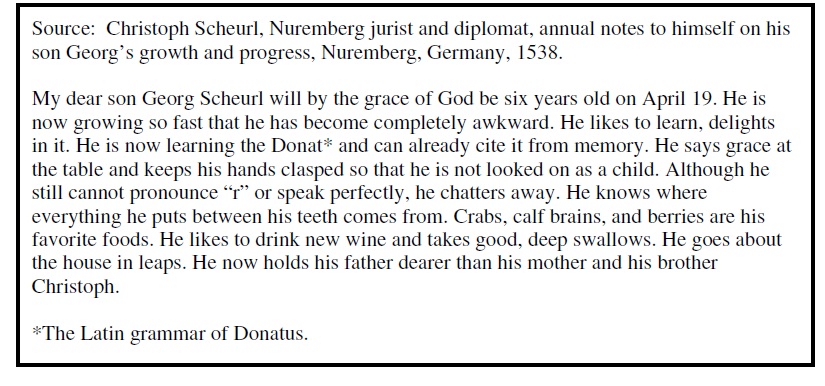
What are some ways to help students penetrate the superficial levels of this source? What are the roots, present but unseen, that underpin this source? Who is Chris Scheurl? How are we to make sense of this source?
Making sense of this source is about more than comprehending its message, though that is an essential part of the process.
We have to understand how this source might provide evidence for various assertions about the past.
Like the iceberg or the plant, we have to wonder about the origins of the source, what brought it into being.
My analysis of this source focused on the following ways it might be used as evidence, revealing to us details about
-the elite------------> Not everyone is society has the same opportunities. What opportunities did this child have?
-how children of the elite were raised
-a well situated father’s view of parenting
-the material wealth of those in the elite→ where they lived, how they lived, what they ate,
-conceptions of childhood. What does it mean to be a 5 or 6 year old, living in a prosperous home, in Nuremberg in 1538?
-the intellectual life of a well to do man living in Nuremberg in 1538. What were his private thoughts, hopes/dreams/fears?
-the role that writing played in this man’s life. How often did he journal? What did he focus on?
The above notes reveal, I think, the act of digging deeper, of not treating a source as a self evident statement of facts.
(Note: I spent as much time on this one source as students have to complete an entire AP Europ DBQ that includes a dozen sources!)
Monday, July 7, 2014
Social Constructs and Point of View Analysis, Part II
Yesterday, I started to discuss how applying the idea of social constructs can help to make source work more meaningful. Before attempting an example, I want to share an excerpt from a reading that I discovered yesterday.
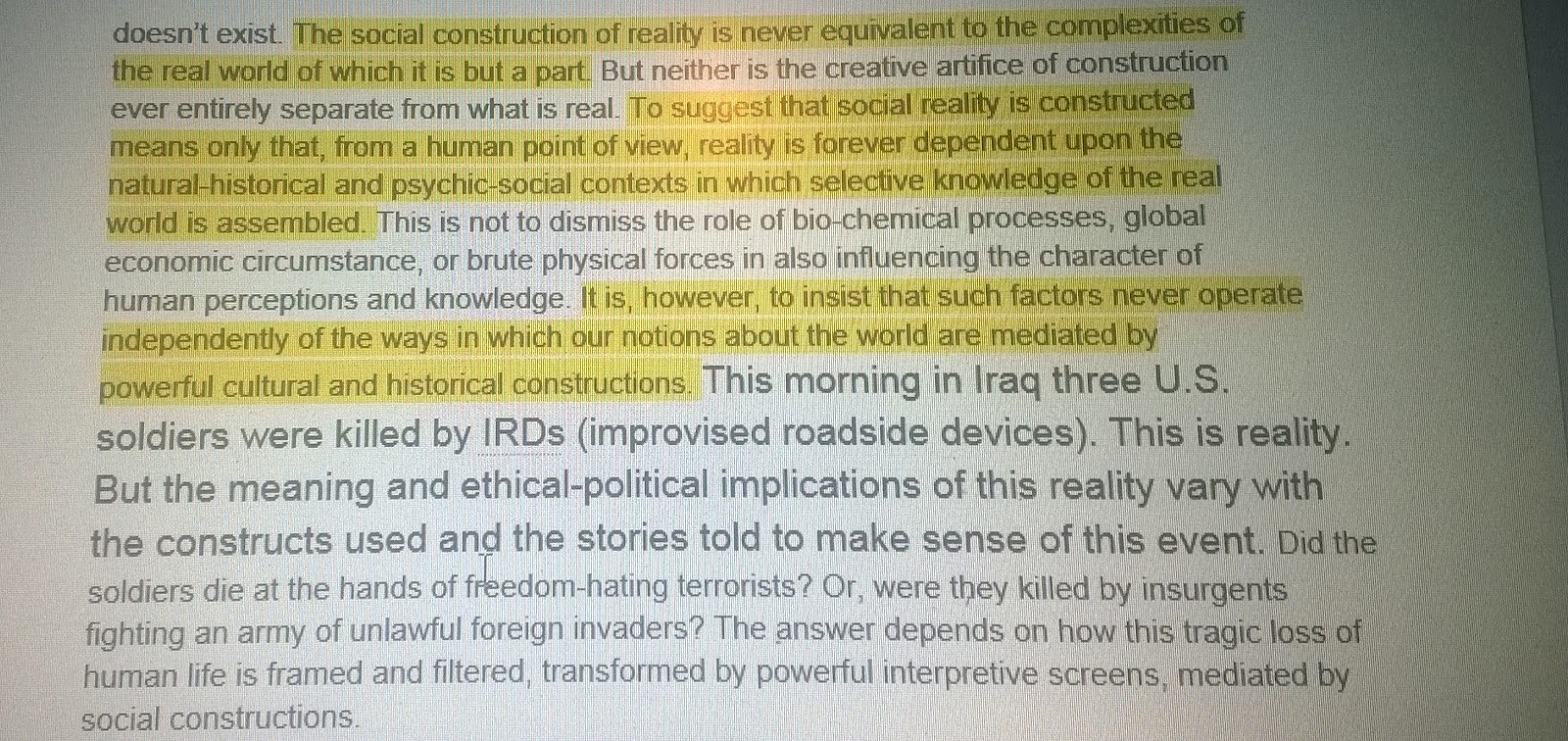
The text I linked to is long, and I have decided to read short sections each day rather than all at once. This section stands out because it links a number of concepts that I have been thinking about, as I explore the nature of perception, especially as it shapes sources and how historians derive meaning from sources. These concepts include: perception (social construction of reality), contexts, meaning, stories, frames and filters, interpretation.
Now, let’s turn our attention back to this source excerpt, which I found in a released AP Euro DBQ.
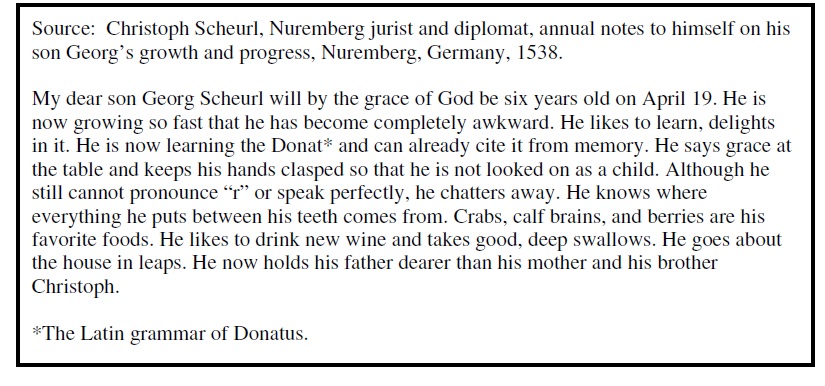
We want students to dig deeper, as opposed to simply reporting or restating the information contained in this source. How can we get them to do that? My thought is that if we have taught them about social construction theory, or at least some of its basic elements, they will have the tools to unlock the deeper meanings embedded in this source.
Where to begin?
They must begin by looking at the author and using the information provided to consider how that may shape the message contained in the source. Christop Scheurl, they are told, was a jurist and diplomat who lived in Nuremberg in 1538. What constructs can they apply to their point of view analysis?
Gender and social class are the two that seem obvious to me.
For what it’s worth, I found a resource (.doc file) yesterday where a teacher uses the following mnemonics (one basic, the other more detailed) to help students think about point of view (POV) analysis:
MAGS: Medium, Audience, Gender, Social Class
ACORNPEG: Audience, Class, Occupation, Religion, Nationality, Political Affiliation, Education, Gender
If we use social class to think about this source, what might that look like? The key question to ask, I think, is as follows: How might social class have influenced or shaped the information Scheurl reveals in his diary entry?
Stepping back for a moment, it is important for us to consider the prompt that this source is tied to.

Scheurl, a jurist and diplomat, was a privileged member of society. This opened doors for his children, providing them with comforts and opportunities that other children would not have automatically received. Scheurl’s diary reveals that his son was receiving a quality education. One that included instruction in Latin. The diary also provides evidence of how this family’s wealth impacted their diet when Scheurl discusses his son’s knowledge of “where everything he puts between his teeth comes from”, including berries, calf brains, crabs, and wine. Parents’ assumptions about their children were influenced by social class. In privileged families, access to education and food combined with parents’ lofty goals for their children to create a comfortable, nurturing environment. This diary entry provides us with a glimpse at how privilege tends to perpetuate privilege. This is revealed both materially and intellectually.
Tuesday, July 1, 2014
Bias, Part II
Yesterday, echoing Sean Lang's text, I started to discuss how commonly the term bias is used by students and teachers in ways that suggest they are misunderstanding the term.
A fundamental point made by Lang is that bias is present in all sources, so asking students *if* a source is biased is like asking students if a fish swims. It’s the wrong the question.
Often, the terms bias and truth or reliability are linked in ways that Lang questions. Since all sources possess bias, asserting that the the existence of bias somehow tells us about the truth or reliability of a source is a leap that does not stand the test of scrutiny. Lang asks, “in rejecting [an author’s bias] must we also reject his conclusions?”
Lang asserts that bias alone is not enough to invalidate an author’s judgement, as is so often suggested by writing prompts and teachers’ questions. Whether or not an author’s judgement is credible, needs to be assessed in other ways. After all, Lang argues, “Without bias, we would know little or nothing about anyone’s opinion of anything.”
In addition, Lang makes the point that “bias is a relative term”. He does not explicitly elaborate on this theme, but, I think, it is a powerful understanding. Let me expand.
When historians, or students who are attempting to apply the mental habits of historians, work with sources, it is important to step back and look at the big picture. No source ought to be viewed as the definitive account of the past. Sets of sources contain multiple perspectives, or biases. Cumulatively, students need to think about the various points of view expressed among the sources, comparing and contrasting them, looking for corroboration and tensions, contradictions and silences.
Fundamental to source work, and discussions of bias, is what questions are being asked of the sources. Are you looking to discover a basic timeline of events in Paris on July 14, 1789? Are you looking to discover how people reacted to these events? Are you interested in how people have remembered these events and how attitudes about the the fall of the Bastille have shifted over time, reflecting the dominant moods of the moment? All of these questions require the sources under examination to be viewed in different ways.
The type of bias, or point of view, that is relevant and given weight changes based on the questions that are posed.
Monday, June 30, 2014
The Use and Abuse of the Term Bias
I set a goal for myself this month to match my published word count from last July, about 9000 words. Rather than write a few lengthy posts, I am going to try to publish short posts each day. If necessary, I will linger on certain topics and themes for a few days, so that I can dig deeper.
Today I reread Sean Lang’s essay ‘What is bias?’. I originally found the article posted online, but I haven’t been able to access it anymore. Luckily, I did print a copy. (I am pretty sure that I have discussed this text before. I will go back and link to that post.)
Lang points out that the term bias is often used by teachers and assessment creators. The frequency that the term is used and the way the term is used is particularly troubling to Lang. In far too many contexts, it appears, the message sent to students is that bias is something that some sources possess and others do not. The message that many students seem to internalize is that biased sources are to be identified and discarded.
Lang spends at least three pages dissecting this fundamentally misguided view of historical source analysis.
I am writing this post without the text in front of me. So, in no particular order, here are some of the points that I took away from my reading of this text. (I will focus on this text for the next few posts).
When you examine how students and teachers use the term bias, they are basically talking about point of view.
The term bias is almost always used pejoratively, as if it is something to be avoided. Is there a substantive difference between bias and point of view? Lang does not think so, though many who use the two terms appear to.
Since there does not appear to be a difference between the two terms, looking for unbiased sources amounts to looking for sources devoid of point of view. If the source has been created by someone, we know, it is shaped by that author, in obvious and subtle ways. This is point of view. And bias, or point of view, is the human imprint.
So rather than asking students *if* a source is biased, as if there is chance it is not, we should ask students a question, such as the following: What are the author's biases and what does this information reveal about the period of time we are studying?
Tomorrow: Are biased sources inherently unreliable? No. Is bias the same as distortion? No.
Subscribe to:
Posts (Atom)