Showing posts with label models. Show all posts

Thursday, July 3, 2014

The Textbook in Our Heads

Of late, I have found myself on reddit, reading various posts to the askhistorians group. This week, these two posts have stood out, exploring reasons to study the past.

This one focuses particularly on the study of history against the backdrop of postmodernism. And this one is more general, a student who is questioning whether his choice to major in history makes sense.

The quality of comments and the depth of the answers, at least on this subreddit, is appealing.


It is quite jarring, I think, for a person who has become accustomed to thinking about the past in binary terms- true or false- to entertain the idea that much of what historians do is subjective, despite the methods of the discipline.

Much of what I have come to think of as good or quality history teaching boils down to helping students explore the nuances of the discipline, its interpretive layers.

At the very least, as a teacher, once you grasp that history is never as simple as ‘just the facts’, you ought to stop trying to spoon feed students facts for recall and start teaching disciplinary concepts that revolve around argument construction and using sources as evidence.

Going back and reading these last few sentences, I can see that I take it for granted that once you grasp that a just the facts notion of studying history is inadequate and not even tenable intellectually, a teacher will move away from it and embrace the interpretive, seemingly more subjective, realm. In fact, I don’t think this is the case. Why?

It’s a major paradigm shift, and, as far as I can tell, students need to be led carefully down the winding corridors of epistemology. It is much easier for a teacher to look at the curriculum guide, count the textbook pages and days, cue up the well worn powerpoint slides, and start teaching. Most parties involved are quite comfortable with this approach to teaching about the past. 

Those in the classroom, as well as those outside of it- colleagues, parents, administrators, the media- often derive great comfort from the traditional narrative arcs embedded in textbooks and History channel docudramas.   
   

Wednesday, July 2, 2014

Bias, part III

Today will be my last post explicitly discussing Lang’s text. Monday and Tuesday’s posts also focused on his essay ‘What is bias?’. If you would like to read more about Lang, I found a talk he gave, where he riffs on the state of history education in England. He is also on Twitter.


In the essay, Lang points out that bias and distortion are not identical concepts. To distort the past, is to make assertions that can be demonstrated false. Does bias sometimes contribute to distortions of the past? Yes, but not always.

Students, Lang argues, often appear to use these terms interchangeably, so that accusations of bias are really just accusations of distorting the past. Typically, students do not have enough source material at their disposal for them to make credible judgments about the extent to which a source can be judged reliable: just because your brother writes a review of your latest book doesn’t mean that the content of the review can immediately be discarded. Though, given the relation of the reviewer to the reviewed, the review may legitimately be viewed with heightened skepticism.


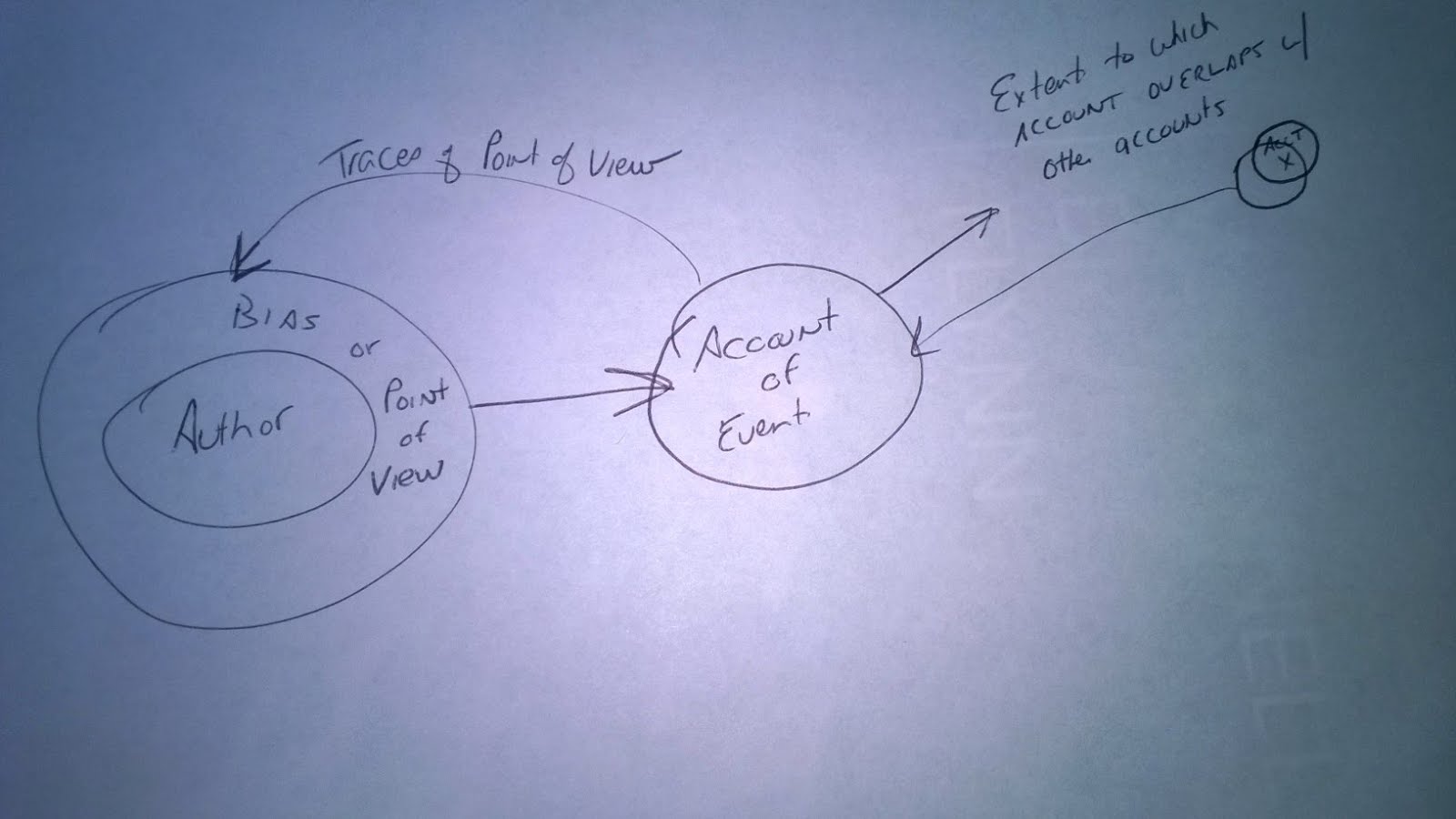
Reflecting on this essay, I am exploring some visuals, or simple models, that might capture some of Lang’s main points.


My Model


Notice that bias and point of view are used synonymously. Also, I encircled the author with bias since all authors possess it. As we know and can clearly see, pointing out that a source is biased is not a meaningful insight. Articulating the kinds of biases and linking them to other points is the historian’s task.


You will also see that I put an account of the past in the center. And I placed an arrow with the words traces of the past going from the account back toward the author. We learn more about the author’s biases through her account of the past (there is more to explore here). On the far right I included the words extent to which account overlaps with other accounts. In my mind, this is where the concept of distorting the past applies. To what extent does this author’s account corroborate or contradict other accounts of the past? This is the only way that judgments about a source’s accuracy can be made. As you can see, linking tightly the terms bias and distortion does not make sense, as they are presented in Lang's text and in my model.           


WP_20140702_001.jpg


Saturday, May 17, 2014

A first model


edit


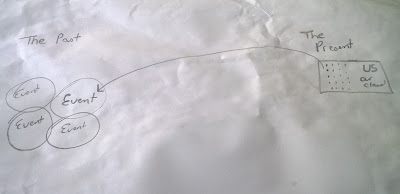
As I mentioned in my previous post, I am thinking about how modeling might be used in a social studies class. I am using the visual above as a potential starting point for some of the modeling that might be done during the first few days of a social studies class.

Most of our students walk in on day one assuming that in a  social studies class they will study the past. And studying the past means learning facts about the past. And doing well in a social studies class is about little more than remembering the facts that the teacher, textbook, and videos say are important. This is what many social studies classes have and continue to look like.

This first model, then, has to get students to unpack and examine these assumptions. If these assumptions are left unchallenged, or, worse, perpetuated, then we are missing an opportunity to teach our students how to think critically about the past and present.

Notice that the arrow flows from the classroom to the past. We need to get students thinking about the idea of the past. What is the past? An easy place to begin a reflection about the nature of the past is to think about our own memories. Human beings do not and cannot remember everything about the past. The memories we store and the artifacts we keep help us to hold on to aspects of the past. Other people who experienced the events we recall also connect us to the past. 

Memories, we know, are not recorded the same way photos or videos of past events are recorded. This has huge implications for accounts of the past based on people's memories. Students need to explore this idea and revisit it every time they encounter first hand accounts of past events. These accounts cannot be treated as inherently accurate. So many factors influence what and how we remember the events we experience. 

The course I teach is Western Civilization. So, for this class, the arrow in the diagram is headed towards Europe's past. Students, who by default are used to be being passive recipients of facts about the past, are more than willing to let their teacher jump right in and start teaching the facts. Resist this urge! I think that the time spent working with models, especially early in the opening days of the course, will pay off as the course progresses. 

There is much more than can be explored and connected to the above model.