Tuesday, July 8, 2014

Digging Deeper


Last night I found a website called Rhetorica that had a page dedicated to discussing media bias. Many of the core ideas on this page overlap with some of the big ideas I have been discussing about the discipline of history.


Specifically, I think, I can tie some of the points made on the Rhetorica page to some of my recent posts discussing social constructions, bias, and source work.


Whenever we give students sources- all sources not just primary sources- it is important for us to model and, ultimately, expect that students will conduct a point of view analysis to unlock meaning from these sources.


The first sentence on the Rhetorica page that I linked to above is this: There is no such thing as an objective point of view. This fact is fundamental to the discipline of history. The author of the Rhetorica page continues,


“No matter how much we may try to ignore it, human communication always takes place in a context, through a medium, and among individuals and groups who are situated historically, politically, economically, and socially. This state of affairs is neither bad nor good. It simply is. Bias is a small word that identifies the collective influences of the entire context of a message.”


When we give students sources, or when they find their own, they need to have an awareness of, or be helped to see, this fundamental, that there is no such thing as an objective, or neutral, point of view.
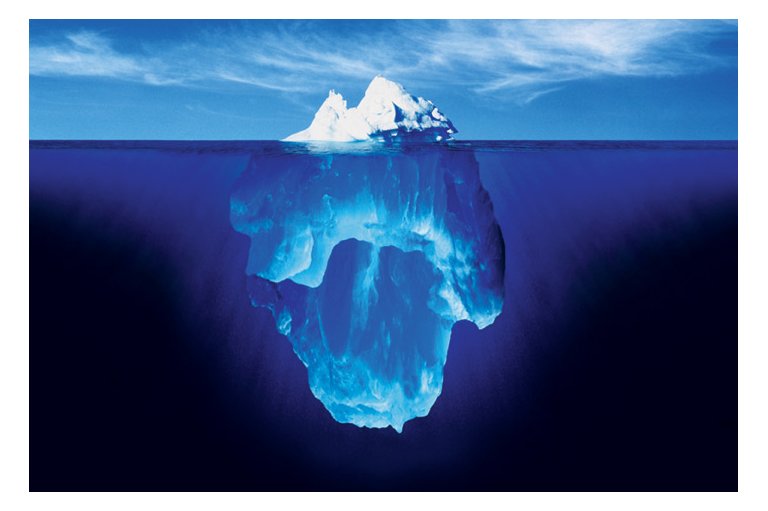

iceberg-poster.jpg
When we give students sources, we want them to think about what’s below the surface. But to do that, they must use what’s visible, and they must use their knowledge. This process is challenging because it is inference based.

shutterstock-plant-roots.jpg


Both of these images, the iceberg and the plant roots, help to illustrate visually that if students are only focused on what’s visible, often the words on the page, they are not focusing on what is beneath the surface. And it is what’s beneath the surface, where meaning making occurs.


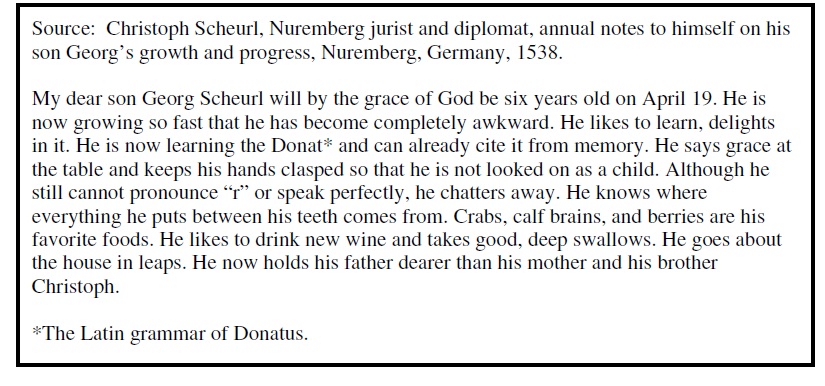
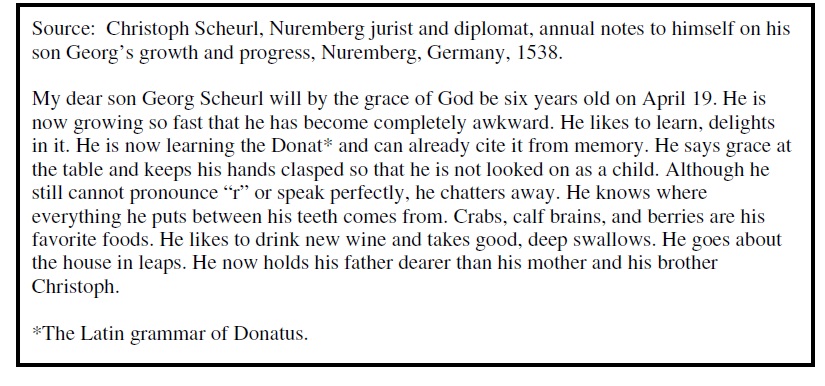
Let’s turn our attention back to the source that I was looking at yesterday, Scheurl’s diary entry.

Scheurl.jpg
What are some ways to help students penetrate the superficial levels of this source? What are the roots, present but unseen, that underpin this source? Who is Chris Scheurl? How are we to make sense of this source?
Making sense of this source is about more than comprehending its message, though that is an essential part of the process.  


We have to understand how this source might provide evidence for various assertions about the past.


Like the iceberg or the plant, we have to wonder about the origins of the source, what brought it into being.  


My analysis of this source focused on the following ways it might be used as evidence, revealing to us details about
-the elite------------> Not everyone is society has the same opportunities. What opportunities did this child have?
-how children of the elite were raised
-a well situated father’s view of parenting  
-the material wealth of those in the elite→ where they lived, how they lived, what they ate,  
-conceptions of childhood. What does it mean to be a 5 or 6 year old, living in a prosperous home, in Nuremberg in 1538?
-the intellectual life of a well to do man living in Nuremberg in 1538. What were his private thoughts, hopes/dreams/fears?
-the role that writing played in this man’s life. How often did he journal? What did he focus on?


The above notes reveal, I think, the act of digging deeper, of not treating a source as a self evident statement of facts.


(Note: I spent as much time on this one source as students have to complete an entire AP Europ DBQ that includes a dozen sources!)



Monday, July 7, 2014

Social Constructs and Point of View Analysis, Part II


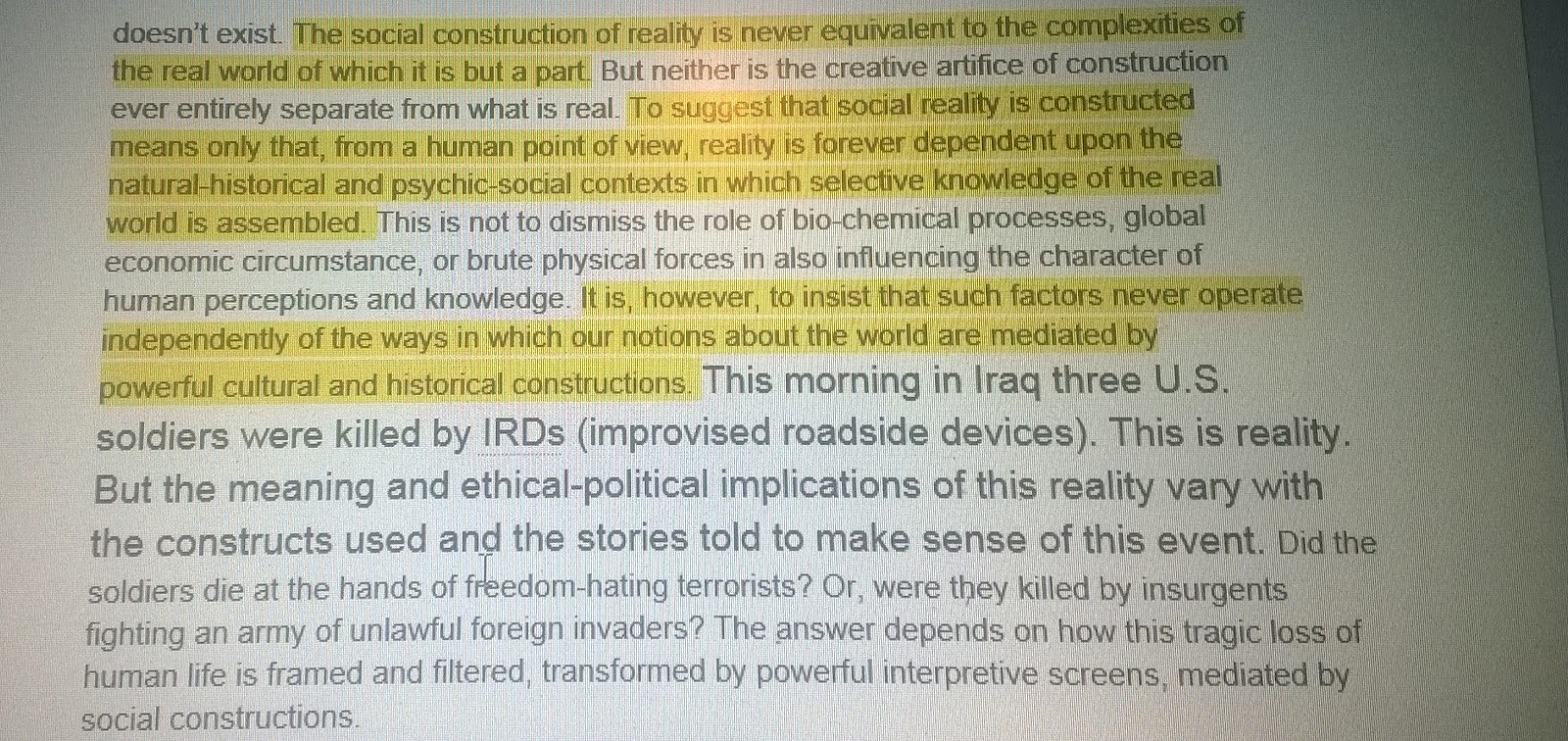
Yesterday, I started to discuss how applying the idea of social constructs can help to make source work more meaningful. Before attempting an example, I want to share an excerpt from a reading that I discovered yesterday.


WP_20140706_012.jpg


The text I linked to is long, and I have decided to read short sections each day rather than all at once. This section stands out because it links a number of concepts that I have been thinking about, as I explore the nature of perception, especially as it shapes sources and how historians derive meaning from sources. These concepts include: perception (social construction of reality), contexts, meaning, stories, frames and filters, interpretation.


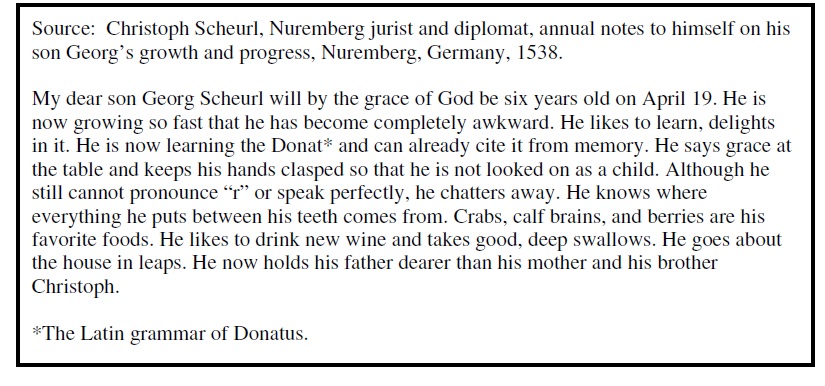
Now, let’s turn our attention back to this source excerpt, which I found in a released AP Euro DBQ.


Scheurl.jpg
We want students to dig deeper, as opposed to simply reporting or restating the information contained in this source. How can we get them to do that? My thought is that if we have taught them about social construction theory, or at least some of its basic elements, they will have the tools to unlock the deeper meanings embedded in this source.


Where to begin?
They must begin by looking at the author and using the information provided to consider how that may shape the message contained in the source. Christop Scheurl, they are told, was a jurist and diplomat who lived in Nuremberg in 1538. What constructs can they apply to their point of view analysis?


Gender and social class are the two that seem obvious to me.


For what it’s worth, I found a resource  (.doc file) yesterday where a teacher uses the following mnemonics (one basic, the other more detailed) to help students think about point of view (POV) analysis:


MAGS: Medium, Audience, Gender, Social Class
ACORNPEG: Audience, Class, Occupation, Religion, Nationality, Political Affiliation, Education, Gender


If we use social class to think about this source, what might that look like? The key question to ask, I think, is as follows: How might social class have influenced or shaped the information Scheurl reveals in his diary entry?


Stepping back for a moment, it is important for us to consider the prompt that this source is tied to.


Thesis.jpg


Scheurl, a jurist and diplomat, was a privileged member of society. This opened doors for his children, providing them with comforts and opportunities that other children would not have automatically received. Scheurl’s diary reveals that his son was receiving a quality education. One that included instruction in Latin. The diary also provides evidence of how this family’s wealth impacted their diet when Scheurl discusses his son’s knowledge of “where everything he puts between his teeth comes from”, including berries, calf brains, crabs, and wine.  Parents’ assumptions about their children were influenced by social class. In privileged families, access to education and food combined with parents’ lofty goals for their children to create a comfortable, nurturing environment. This diary entry provides us with a glimpse at how privilege tends to perpetuate privilege. This is revealed both materially and intellectually.         


Sunday, July 6, 2014

Social Constructions and Source Work


This past week I have read and listened to Barbara J Fields (more Fields) and Judith Butler (more Butler) for the first time. Both names were suggested by David Salmanson in a blog post about theory for high school teachers.


The more I come to terms with the subjective nature of historical analysis, the more I have to inform myself about the structures that underpin historical narratives and the concepts and theories that have been advanced to help us to think about the various social constructs that influence our perceptions.


We know that students and many (?) teachers have a difficult time thinking about history as more than just facts about the past that are passed down from generation to generation. The more I read and think about various constructs, such as race, gender, notions of time, and religion, I realize that when I examine a source, one of my fundamental jobs is to look for evidence of these constructions, to define them and to place them into a larger context.  For example, here is a source that I recently encountered when examining a released AP Euro DBQ:


Scheurl.jpg
Before my knowledge about how historians do their job evolved, I would have looked at a source like this as a repository of facts that could be identified and remembered, adding to my store of knowledge about the past. We know that this is the way many students continue to view the discipline of history, even in classes where working with a variety of primary and secondary sources is emphasized.


Instead, a source like this needs to be examined from a variety of angles. It needs to be deconstructed, questioned, and ultimately, if it can be used to support a thesis, included in an interpretation about the past.


What I’d like to do over the next few days is to actually apply the ideas I have been discussing to this particular source.


More tomorrow...


Update

Here are two additional resources that I think will help me dig deeper.
http://oyc.yale.edu/sociology/socy-151/lecture-1 (part of a whole course)
http://trabal.org/gtheory/wp-content/uploads/2008/01/pfohl2008.pdf


Saturday, July 5, 2014

Evidence

Capturing vs Interpreting the Past


I have been listening to and, now, viewing some of Dr. Darren Reid’s podcasts and Youtube videos to better appreciate what historical analysis sounds like.


What are some of the ideas and  themes embedded in his thinking, particularly when reviewing a film about the past?


-Those who create- authors, filmmakers, artists- have a worldview that shapes what they create. Individual worldviews also reveal certain elements of the larger society. Worldviews shape perceptions.


-Movies need to be analyzed on multiple levels.
One level of analysis involves analyzing how accurately events of the past are portrayed in this film.

-Films have narratives.
Storytelling can be concrete or abstract.

Reid asks: What does it mean to have an historically accurate movie?

Reid: For an historian, what is accuracy? “Describing the past based on evidence and sound analysis.”

Reid discusses how movies, tv, and even video games “work as the historian for the larger public consciousness.” Further, he wonders, what obligations do these mediums have to depict the past accurately? And what are the consequences of inaccurate portrayals of the past? Does it matter?


Reid: “Historical accuracy in films does not, nor can it, exist.” What does he mean?


When someone asks, whether or not a film is historically accurate, they appear to mean the following: Did the events depicted in the film happen? And if so, did they happen in ways they are shown in the film?


Reid: “History is a difficult beast to tame.”

Paraphrasing him: While it is tempting to think of the past as something that can be captured, as a “grand story” that can be perceived and recreated on screen, “the truth of the matter is far more complex than that.”


Films are never “just about the period which [they] purport to” portray. In the movie being analyzed, "The New World", Reid asserts that the “weight of the past 400 years” is present.


Films tackle some, but not all, issues, controversies, and perspectives. Which issues are not engaged with? Why?

Reid: “In short, historic films often tell us more about the time when they were made then they do about the time they depict.”-Movies are shaped by the individuals who create them. And they are often (always?) “reshaped to suit modern sensibilities”.

Big Idea: Must keep in mind when watching a movie about the past that we are getting someone’s vision/interpretation of the time period. We are not getting an unfiltered glimpse of the past, as much as the medium may make us feel and think that that is what we are getting.

Two related but different ideas discussed by Reid: historical authenticity and historical accuracy (need to explore these ideas more).


Friday, July 4, 2014

Thematic Planning and Teaching

Last night's #inquirychat focused on the concept of thematic teaching. One of the points that is on my mind has to do with the extent to which a thematic approach is at odds with a chronological approach. I am not sure this is the case, though in the chat it appeared to be expressed as such.

I should probably start with some definitions.

During last night's chat, I defined a theme as a recurring, organizing idea. I then proceeded to define themes as big questions, particularly questions focused on disciplinary concepts. In the course of the chat, words such as justice, equality, and nationalism were all mentioned as possible themes.


For me, it is always helpful to think about the non example. What does a teacher who is NOT teaching thematically doing, or not doing?


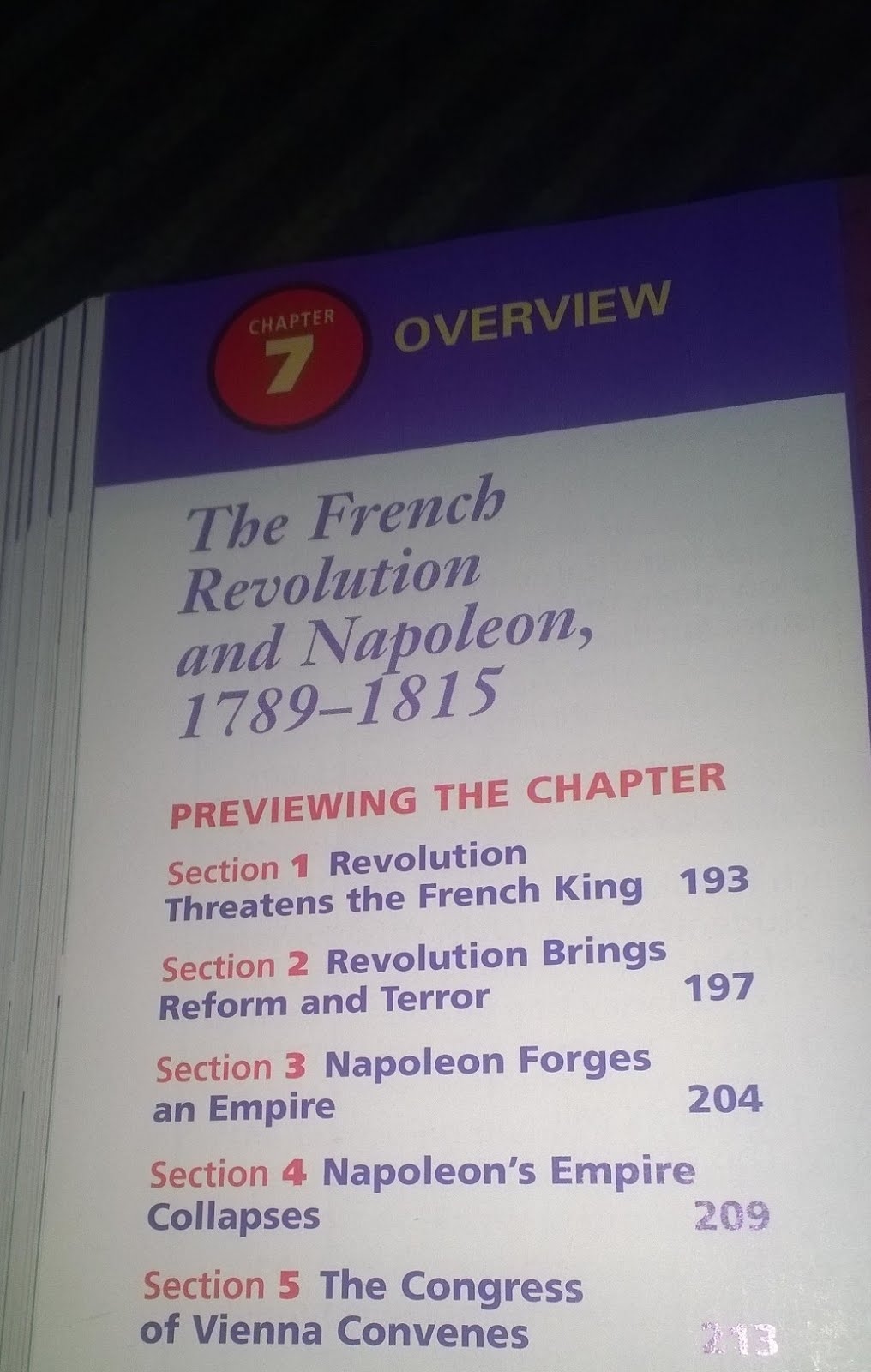
Let's picture them opening up the textbook and talking about the French Revolution, section by section. And then students are tested. Traditional history teaching personified. I do not consider this thematic teaching because there is no attempt to tie the material to larger ideas or themes. If we think about how a textbook is organized, it is often around events. For example, the Western Civ textbook my school uses has the following sections for the French Revolution:


WP_20140704_001.jpg


The first section is organized in the following way:
Section 1- Revolution threatens the French King
Sub topics
Old Regime
The Forces of Change
Revolution Dawns
A Great Fear Sweeps France


The textbook is presenting the French Revolution the way most textbooks do, as a series of events. The book is telling a story. It is not simply a list of facts. So, to that extent, there are unstated themes ( I will talk about this more).


What about the theme of revolution? Would that work here?


It seemed from the chat that some conceptions of thematic teaching would look like this:


Unit Theme= Revolution
Examine the use of the word revolution, as it has appeared recently in the news.
Study French Revolution
Study Russia Revolution


Notice that in this formulation the teacher appears to jump from the French Rev to the Russian Rev. I do not think this approach works, at least for me. And I do not think that thematic teaching has to look this way.


More tomorrow...