The historian is no different from anyone else in that she cannot shed her point of view (POV). POV is how a person sees the world. It is the lens of perception that colors and filters how a person interprets. POV is shaped by one's culture, experiences, and values.
Historians approach the past from a position in the present. The historian is not a detached observer of the past, simply reporting what happened. Unbiased accounts or so called objective histories do not exist because historians are not able to shed their point of view, and the sources they use to inform their interpretations are colored with the point of view of those who created them in a different time and place.
Newly created sources and sources that happen to have survived for decades or even centuries retain both the intellectual imprints of their creators, as well as the times they were created. This is what makes sources valuable. This is also what makes reading sources an exercise in inference and reading between the lines.
The interaction between the historian and the past is far from simple. Equally complex is the interaction between the reader and the works of historians, and the reader and his attempt to makes sense of original sources, which are fragments of the past.
The sources historians handle to answer their questions about the past will also have been created at particular moments in time by people with particular points of view. How historians approach sources depend on the questions they are asking. As a prerequisite, obviously, the historian always needs to be sure that a source is what they think it is. This is the process of authenticating a source. Is this actually a letter written in 1917 by an English soldier to his mother? The process of authentication is not typically performed by our students, though if you are using sources that have been adapted to modern language or excerpted for brevity, it is necessary to talk to students about this process.
Once a source is determined to be authentic, not to be confused with a determination of primary vs. secondary, a series of questions needs to be asked and answered. Most of the questions you ask are going to be tied to the big question that you are trying to answer. Some general questions that you are going to want to ask of all sources include the following:
What kind of source is this? Is it a letter, a diary entry, a newspaper article, government statistics, another historian’s perspective on this topic?
Why does source type matter? The inferences a researcher derives from sources are shaped by the type of source. First, it is necessary to make sure that the sources you are using align to the question you are researching.
For example, if you are reading soldiers' letters home you must remember that these letters were often read by the military before they were allowed to be sent home. Soldiers were aware of this and often self censored. To pursue a research question about soldiers' attitudes during World War I, you would have to rely on more than just letters. Other writings help to inform this question, including works of fiction such as stories and poems.
If you are looking for evidence of changes in economic conditions in post civil war America, you might look at newspapers or tax data. In both cases, you are not interested in the motivations of the authors of these sources in the same way as you were when reading the soldiers' letters. This is because your research question is different. If you were looking for evidence of anti Semitism in post WWII America and you were examining various newspapers, you would scrutinize much more closely the people responsible for publishing the newspaper and its contents, as well as information about its readers.
And how does the type of source I am reading, in the context of my research question, impact my reading of it?
Keith Barton and Sean Lang remind us that questions about a source's reliability are often misplaced. Reliable for what? Questions about reliability must always be asked in the context of one's research question. Remember, reliability is not the same as authenticity. And, unfortunately, reliability, in the minds of many students, is code for bias. Teachers need to be thoughtful about teaching students that point of view and bias are linked. Reliability, on the other hand, has to do with how well a source informs a research question. A source may be reliable for one research question and unreliable for another. Reading tax data to learn about soldiers' attitudes during a war is an example of using a source in a way that is unreliable in light of the research question.
Other questions to consider...
Under what circumstances was this source created? And how does this contextual information impact how I read this source?
How might I be able to use this source? As evidence of…..
Showing posts with label reliability. Show all posts
Showing posts with label reliability. Show all posts
Saturday, July 19, 2014

Saturday, April 19, 2014
The theme for this month’s blog circle post is ‘How to Assess Historical Thinking’.
What do students who DO NOT grasp the ideas and skills associated with sourcing tend to do?
Historical Thinking Skills take Time to Teach
Few, if any, historical thinking skills (HTS) can be learned in a single lesson. HTS are often not intuitive and require considerable practice and feedback. In future blog posts, I want to explore how I am going to set up my course so that I can teach these skills systematically and, ultimately, more effectively.
The HTS that I chose to focus on for this blog post is the skill of sourcing a document or photo.
Overview/Some Commentary
The mentality that we need to help students learn to avoid is just accepting a source at face value. This, I am reminded repeatedly, is the default mentality for most students and, I suspect, many adults, as well.
How do we do this? We do this by reminding students that since all primary and secondary sources are created by people, they need to viewed with an eye for the creator’s point of view and goals, both of which exist in a specific context. (Note: Historian Keith Barton reminds us that not all sources provide testimony. And because all sources DO NOT provide testimony, a simple sourcing heuristic is not always helpful. Issues of reliability and credibility are, obviously, most relevant when we are reading sources created for the purpose of transmitting a message and meaning, such as a letter or speech. Once a source's authenticity has been established, issues of credibility are NOT relevant when an historian is using evidence from the time period that does not provide testimony, such as receipts, newspaper ads, or government statistics...(make sense? I may need to review Barton and revise this section.))
What do students who DO NOT grasp the ideas and skills associated with sourcing tend to do?
A basic or novice understanding of sourcing involves a reader approaching a source with the following in mind:
Bias = bad, Unbiased = Good
We need to create experiences that helps students move beyond these simplistic notions.
Novice views of Sourcing
-If the source expresses bias, it cannot be used. Therefore, the source should be discarded.
-It IS possible and desirable to find and use unbiased source. This, after all, students assume, is what historians spend most of their time trying to do, discovering 'the truth' by finding unbiased sources that reveal it.
-Textbooks are an excellent place to turn if one is looking for an unbiased source.
-Primary sources provide us with a direct window to the past (using SHEG Stanford’s rubric language here with ‘direct window to the past.’)
Understandings that we should help our students move toward.
Any time an historian encounters a source of information, they analyze it to decide if and how they may use it in an historical argument.
All of us, whether historians or not, need to think about and analyze where the information we encounter is coming from. Otherwise, we have no way to judge the best way to respond to that content.
When we source, we can be more confident that we have answers to the following questions: What are we to make of this source? What meanings can we derive and infer from this source? Is this source trustworthy? How do we make this judgment? What parts of this source should we reject and why? What parts of this source should we accept and why?
What did I do in the classroom?
I set up this exercise using a source depicting Louis XVI’s execution. I was not able to determine the origin of this source. For the purpose of this assignment, I told students that we were going to assume it was created in 1830. Why did I have to give them a year? And why did I choose 1830? I knew that handing them a source and providing them with no information about who created it and when undermined the sourcing that I was going to have them do. I chose 1830 because I wanted to force students to think about the distance between the execution of Louis and the (supposed) creation of this source. What impact did over three decades have on how students interpreted this source?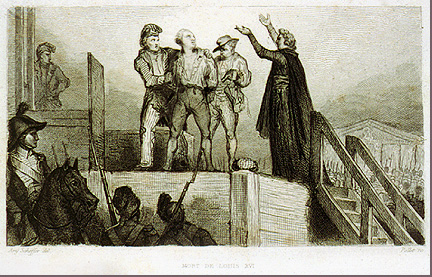
What did I do in the classroom?
I set up this exercise using a source depicting Louis XVI’s execution. I was not able to determine the origin of this source. For the purpose of this assignment, I told students that we were going to assume it was created in 1830. Why did I have to give them a year? And why did I choose 1830? I knew that handing them a source and providing them with no information about who created it and when undermined the sourcing that I was going to have them do. I chose 1830 because I wanted to force students to think about the distance between the execution of Louis and the (supposed) creation of this source. What impact did over three decades have on how students interpreted this source?
How did I set this up?
Here are some questions that I used in class.
What is a source? (Some points to make/questions to ask: Are all sources the same? Should we treat a letter from a soldier to his wife differently than we might treat a collection of receipts or government statistics? If so, why? What's the difference?
Key point: A source is someone/something from which we get information. Students are often desensitized to the sources they encounter regularly, especially textbooks and teachers. Student desensitization is evident when their default is to accept information on face value that is provided by teachers and textbooks.)
Key point: A source is someone/something from which we get information. Students are often desensitized to the sources they encounter regularly, especially textbooks and teachers. Student desensitization is evident when their default is to accept information on face value that is provided by teachers and textbooks.)
Why is it important to question a source? (Some points to make/questions to ask: And what do we even mean by questioning a source? When we question a source, what kinds of questions should we ask? Some expected student responses to the importance of questioning a source:
So you can decide whether or not to believe the information.
So you can evaluate how accurate the information is.
(What are some points that I ought to make at this point in the lesson? Or at some point in this lesson? A source can often tell us much more than it literally says. It can tell us about the time period being studied. We need to interrogate a source in order to arrive at some of the more subtle meanings and messages contained within a source. When we get information we need to think about how the messenger influences the message. Source work is conducted for a reason. When historians are working with sources, whether primary or secondary, it is because they are trying to answer certain questions about the past.
How did I transition to the activity?
Tell students that sourcing is the first step in historical analysis, in thinking like an historian (see Big Six: 47).
Some sourcing questions are straightforward.
When was this source written/created?
Who created it?
What was the creator’s point of view? How do we know?
The Big Six text discusses how sourcing questions can become more subtle, abstract, and inference based. The big idea here, I think, is that we need to take what we have learned via our sourcing questions and draw some inferences, make some educated predictions about the reliability and usefulness of the source.
Based on our sourcing questions and answers, we to consider the creator of the source’s agenda: their purpose, goal(s) and motivations. And we need to keep these factors in mind when making judgments about the source.
For example, just because Napoleon says something happened, doesn’t mean that it happened exactly as he says. Napoleon’s words, though, do reveal aspects of his personality and character. They also tell us about his world, what was going on around him. For this reason, once we identify and account for a source's main biases, we can use the source to support our arguments about the past.
How reliable is this source? It depends on the historical questions you are asking.
Questions of reliability need to be precisely stated. Reliability does not just exist out there, as a concept. Reliable how? If this source is being used to consider how artists at different moments in time have portrayed Louis’ execution, then this source is reliable, in as far as it tells us something about the time period when it was created. If this source is being considered as evidence of how Louis XVI acted in the moments leading up to his execution, then it may be less reliable, given (at least for the purpose of this assignment) that it was created thirty years after his execution.
How did students interpret this source?
Some students were quick to describe the image, an essential beginning step in analyzing a source. It is necessary, however, that we teach students that they need to do more than just describe what they read or what they see. They need to link these observations to larger questions and answers. When students do this, they are beginning to think like an historian.
Here are some student comments that I’d like to consider (I have more that I will add and comment on) as I think about my rubric (linked below) and historical thinking in general:
Some student comments describing the image, describing Louis.
“Louis looks depressed.”
“..he must be scared. He is about to die. He acted calm and collected.”
“He listened to all of the orders he was given.” (We need to push the student to tell us why he is saying this. Is this accurate? We cannot determine the accuracy of this from a single source.)
“It is a picture of Louis getting executed.” (Though true, a basic observation.)
More comments will be added...
More comments will be added...
Additional Comments/Thoughts
-Some students may not even attempt to ‘close view/read’ the source. We should be able to discern whether or not a student has taken the time to view the source, to make some observations. Some students may 'close view' the source and see things that are not actually there. It is important that our rubric accounts for both possibilities.
-Some students may not even attempt to ‘close view/read’ the source. We should be able to discern whether or not a student has taken the time to view the source, to make some observations. Some students may 'close view' the source and see things that are not actually there. It is important that our rubric accounts for both possibilities.
Link to my Rubric ( I need to spend more time thinking about and writing about how I used this rubric and how it may need some revision.)
Subscribe to:
Posts (Atom)