Friday, July 4, 2014

Thematic Planning and Teaching

Last night's #inquirychat focused on the concept of thematic teaching. One of the points that is on my mind has to do with the extent to which a thematic approach is at odds with a chronological approach. I am not sure this is the case, though in the chat it appeared to be expressed as such.

I should probably start with some definitions.

During last night's chat, I defined a theme as a recurring, organizing idea. I then proceeded to define themes as big questions, particularly questions focused on disciplinary concepts. In the course of the chat, words such as justice, equality, and nationalism were all mentioned as possible themes.


For me, it is always helpful to think about the non example. What does a teacher who is NOT teaching thematically doing, or not doing?


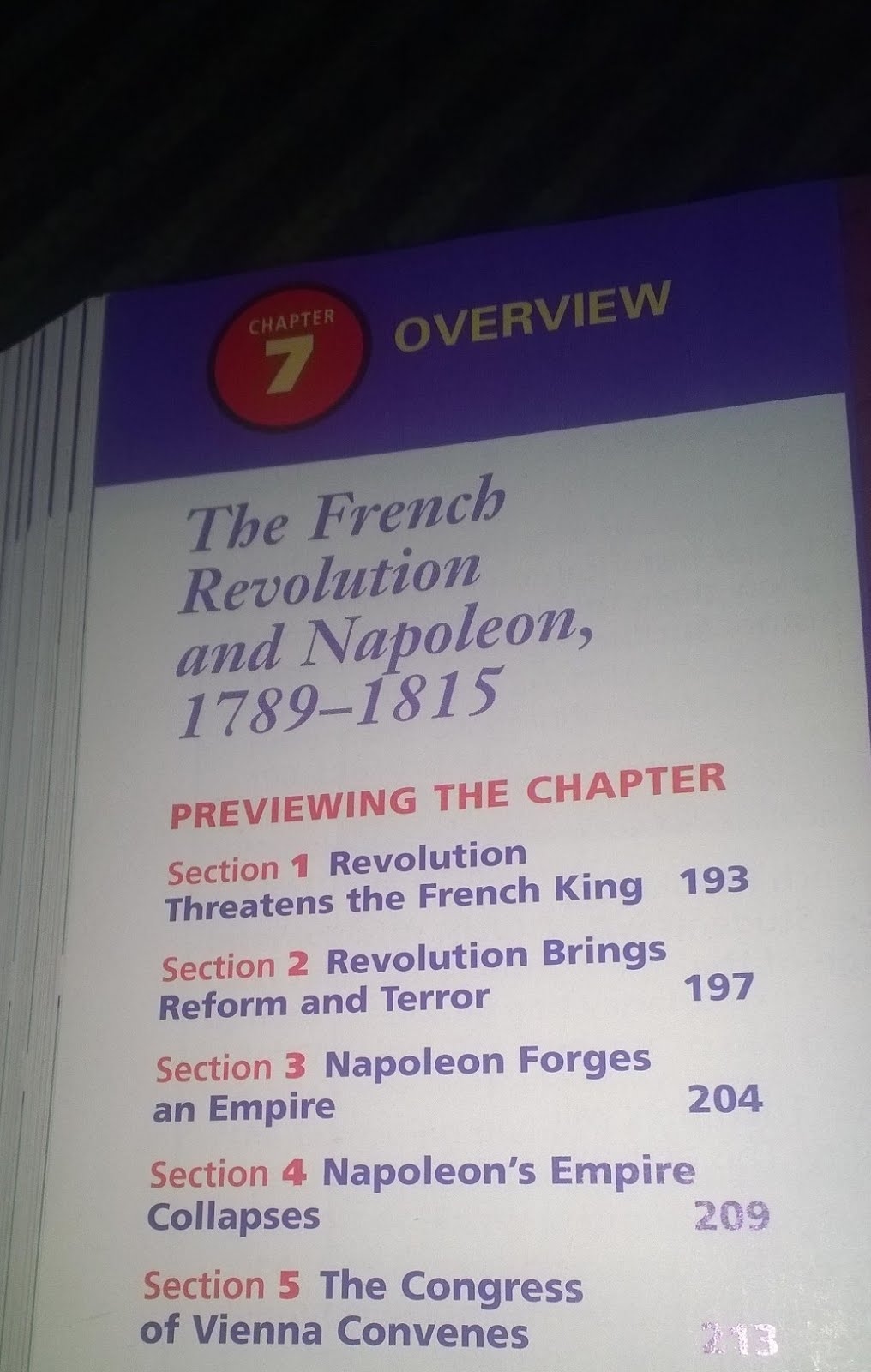
Let's picture them opening up the textbook and talking about the French Revolution, section by section. And then students are tested. Traditional history teaching personified. I do not consider this thematic teaching because there is no attempt to tie the material to larger ideas or themes. If we think about how a textbook is organized, it is often around events. For example, the Western Civ textbook my school uses has the following sections for the French Revolution:

WP_20140704_001.jpg


The first section is organized in the following way:
Section 1- Revolution threatens the French King
Sub topics
Old Regime
The Forces of Change
Revolution Dawns
A Great Fear Sweeps France


The textbook is presenting the French Revolution the way most textbooks do, as a series of events. The book is telling a story. It is not simply a list of facts. So, to that extent, there are unstated themes ( I will talk about this more).


What about the theme of revolution? Would that work here?


It seemed from the chat that some conceptions of thematic teaching would look like this:


Unit Theme= Revolution
Examine the use of the word revolution, as it has appeared recently in the news.
Study French Revolution
Study Russia Revolution


Notice that in this formulation the teacher appears to jump from the French Rev to the Russian Rev. I do not think this approach works, at least for me. And I do not think that thematic teaching has to look this way.


More tomorrow...


Thursday, July 3, 2014

Ideology and Race in American History, Barbara J. Fields

"Ideologies are the eyes through which people see social reality, the form in which they experience it in their own consciousness."


The Textbook in Our Heads

Of late, I have found myself on reddit, reading various posts to the askhistorians group. This week, these two posts have stood out, exploring reasons to study the past.

This one focuses particularly on the study of history against the backdrop of postmodernism. And this one is more general, a student who is questioning whether his choice to major in history makes sense.

The quality of comments and the depth of the answers, at least on this subreddit, is appealing.


It is quite jarring, I think, for a person who has become accustomed to thinking about the past in binary terms- true or false- to entertain the idea that much of what historians do is subjective, despite the methods of the discipline.

Much of what I have come to think of as good or quality history teaching boils down to helping students explore the nuances of the discipline, its interpretive layers.

At the very least, as a teacher, once you grasp that history is never as simple as ‘just the facts’, you ought to stop trying to spoon feed students facts for recall and start teaching disciplinary concepts that revolve around argument construction and using sources as evidence.

Going back and reading these last few sentences, I can see that I take it for granted that once you grasp that a just the facts notion of studying history is inadequate and not even tenable intellectually, a teacher will move away from it and embrace the interpretive, seemingly more subjective, realm. In fact, I don’t think this is the case. Why?

It’s a major paradigm shift, and, as far as I can tell, students need to be led carefully down the winding corridors of epistemology. It is much easier for a teacher to look at the curriculum guide, count the textbook pages and days, cue up the well worn powerpoint slides, and start teaching. Most parties involved are quite comfortable with this approach to teaching about the past. 

Those in the classroom, as well as those outside of it- colleagues, parents, administrators, the media- often derive great comfort from the traditional narrative arcs embedded in textbooks and History channel docudramas.   
   

Wednesday, July 2, 2014

Bias, part III

Today will be my last post explicitly discussing Lang’s text. Monday and Tuesday’s posts also focused on his essay ‘What is bias?’. If you would like to read more about Lang, I found a talk he gave, where he riffs on the state of history education in England. He is also on Twitter.


In the essay, Lang points out that bias and distortion are not identical concepts. To distort the past, is to make assertions that can be demonstrated false. Does bias sometimes contribute to distortions of the past? Yes, but not always.

Students, Lang argues, often appear to use these terms interchangeably, so that accusations of bias are really just accusations of distorting the past. Typically, students do not have enough source material at their disposal for them to make credible judgments about the extent to which a source can be judged reliable: just because your brother writes a review of your latest book doesn’t mean that the content of the review can immediately be discarded. Though, given the relation of the reviewer to the reviewed, the review may legitimately be viewed with heightened skepticism.


Reflecting on this essay, I am exploring some visuals, or simple models, that might capture some of Lang’s main points.


My Model


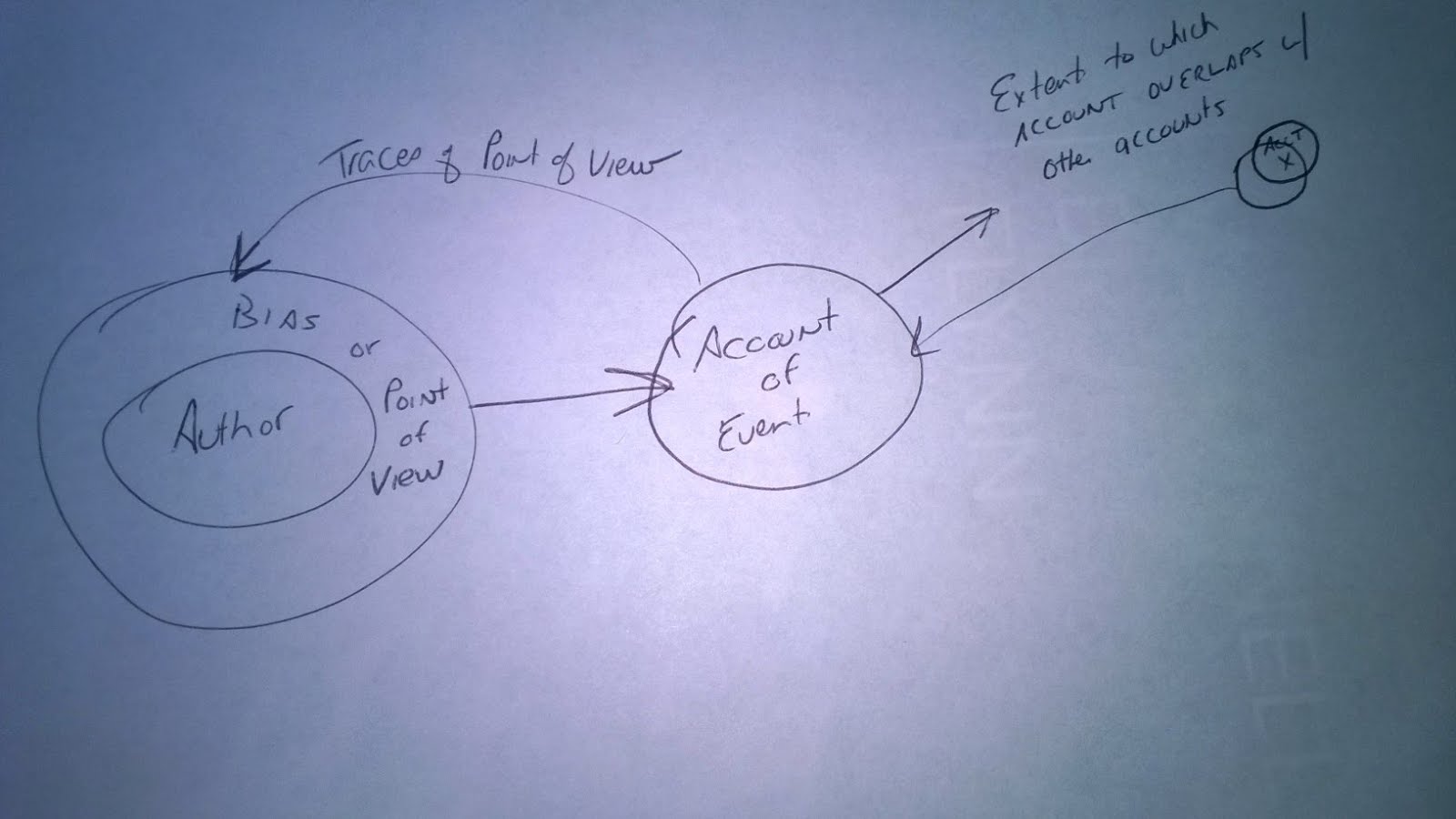
Notice that bias and point of view are used synonymously. Also, I encircled the author with bias since all authors possess it. As we know and can clearly see, pointing out that a source is biased is not a meaningful insight. Articulating the kinds of biases and linking them to other points is the historian’s task.


You will also see that I put an account of the past in the center. And I placed an arrow with the words traces of the past going from the account back toward the author. We learn more about the author’s biases through her account of the past (there is more to explore here). On the far right I included the words extent to which account overlaps with other accounts. In my mind, this is where the concept of distorting the past applies. To what extent does this author’s account corroborate or contradict other accounts of the past? This is the only way that judgments about a source’s accuracy can be made. As you can see, linking tightly the terms bias and distortion does not make sense, as they are presented in Lang's text and in my model.           


WP_20140702_001.jpg


Tuesday, July 1, 2014

Bias, Part II

Yesterday, echoing Sean Lang's text, I started to discuss how commonly the term bias is used by students and teachers in ways that suggest they are misunderstanding the term.                         


A fundamental point made by Lang is that bias is present in all sources, so asking students *if* a source is biased is like asking students if a fish swims.  It’s the wrong the question.


Often, the terms bias and truth or reliability are linked in ways that Lang questions. Since all sources possess bias, asserting that the the existence of bias somehow tells us about the truth or reliability of a source is a leap that does not stand the test of scrutiny.  Lang asks, “in rejecting [an author’s bias] must we also reject his conclusions?”


Lang asserts that bias alone is not enough to invalidate an author’s judgement, as is so often suggested by writing prompts and teachers’ questions. Whether or not an author’s judgement is credible, needs to be assessed in other ways. After all, Lang argues, “Without bias, we would know little or nothing about anyone’s opinion of anything.”


In addition, Lang makes the point that “bias is a relative term”. He does not explicitly elaborate on this theme, but, I think, it is a powerful understanding. Let me expand.


When historians, or students who are attempting to apply the mental habits of historians, work with sources, it is important to step back and look at the big picture. No source ought to be viewed as the definitive account of the past. Sets of sources contain multiple perspectives, or biases. Cumulatively, students need to think about the various points of view expressed among the sources, comparing and contrasting them, looking for corroboration and tensions, contradictions and silences.


Fundamental to source work, and discussions of bias, is what questions are being asked of the sources. Are you looking to discover a basic timeline of events in Paris on July 14, 1789? Are you looking to discover how people reacted to these events? Are you interested in how people have remembered these events and how attitudes about the the fall of the Bastille have shifted over time, reflecting the dominant moods of the moment? All of these questions require the sources under examination to be viewed in different ways.


The type of bias, or point of view, that is relevant and given weight changes based on the questions that are posed.   
       

Monday, June 30, 2014

The Use and Abuse of the Term Bias


I set a goal for myself this month to match my published word count from last July, about 9000 words. Rather than write a few lengthy posts, I am going to try to publish short posts each day. If necessary, I will linger on certain topics and themes for a few days, so that I can dig deeper.


Today I reread Sean Lang’s essay ‘What is bias?’. I originally found the article posted online, but I haven’t been able to access it anymore. Luckily, I did print a copy. (I am pretty sure that I have discussed this text before. I will go back and link to that post.)


Lang points out that the term bias is often used by teachers and assessment creators. The frequency that the term is used and the way the term is used is particularly troubling to Lang. In far too many contexts, it appears, the message sent to students is that bias is something that some sources possess and others do not. The message that many students seem to internalize is that biased sources are to be identified and discarded.


Lang spends at least three pages dissecting this fundamentally misguided view of historical source analysis.


I am writing this post without the text in front of me. So, in no particular order, here are some of the points that I took away from my reading of this text. (I will focus on this text for the next few posts).  


When you examine how students and teachers use the term bias, they are basically talking about point of view.

The term bias is almost always used pejoratively, as if it is something to be avoided. Is there a substantive difference between bias and point of view? Lang does not think so, though many who use the two terms appear to.

Since there does not appear to be a difference between the two terms, looking for unbiased sources amounts to looking for sources devoid of point of view. If the source has been created by someone, we know, it is shaped by that author, in obvious and subtle ways. This is point of view. And bias, or point of view, is the human imprint.

So rather than asking students *if* a source is biased, as if there is chance it is not, we should ask students a question, such as the following: What are the author's biases and what does this information reveal about the period of time we are studying? 

Tomorrow: Are biased sources inherently unreliable? No. Is bias the same as distortion? No.  


Saturday, June 14, 2014

Some historical thinking sentence starters


This is an attempt to construct some sentence starters that help to scaffold historical thinking, reasoning. In the comments, please suggest others or revisions to mine. In addition, once I am satisfied with the list, I will try to categorize the sentence starters.

1. Based on this evidence, it appears that_________________________.

2. This statement reveals (suggests) that _____________________________.

3. We must consider these words in the larger context of ___________________________.

4. When placed into context, this passage takes on a different meaning. Now we see that ______________________________________.
5. When we compare this text to _______________(another text), we see that a tension exists between _________________ and ______________________.

6. Internally, there are some tensions evident in this text. For example, ________________________________. 
7. This text must be placed into a larger context. That context is ________________________. In light of this context, we can assert that _________________________________.

-If we do not take these words literally, then we can take these words to suggest that ____________________________.

8. This source tells us about __________________________.
9. This story/account is told from the perspective of ____________________.
10. The creator of this source appears to be sympathetic to the idea that ___________________.
11. The author created this source in order to ___________________________________. He expected it would be read by _________________________.
12. I am reading this source with the following question(s) in mind:________________________________________________________
13. This source reveals how people thought about ___________________________
14. This source provides some insight into the nature of __________________________.
15. Before reading this source (excerpt), you should know that at the time this source was created ______________________________.
16. This source is a response to __________________________________.
17. The author of this source was ______________________. Some of the preexisting ideas, assumptions that this person had were ___________________________, which would have shaped how he saw the events he witnessed.
18. The author of this source stood to benefit from _________________________.
19. This source triggers the following emotional responses in me _____________________________. (Are these the  emotions the author was trying to elicit?)
20. The ideas contained in this text can be corroborated when juxtaposed against ___________________________________ (another text).
21. Are the actions depicted in this text accurate? How do we know?
22. This source tells us something about _________________________________________.


Impt to consider
Who wrote the document?
Who read the document?
Having read the document, how do I feel about it?
Having read the document, what are we to make of it? Is it reliable? If so, in what ways?

*Many of these sentence starters have been pulled from @thathistorian's podcasts, where he models historical thinking and source work.


Some other big ideas to consider/notes to myself...
Our creations/artifacts both reflect AND shape how we think.
Stereotypes both reinforce and shape ideas (often damaging) about groups.
Meaning needs to be decoded.