Saturday, May 3, 2014

Social Studies Ed is not just History Ed

Being a social studies educator is not the same as being a history teacher. What are the implications of this?


I think they are quite profound.


Many who choose to teach social studies are initially attracted to the field because they want to teach history. In fact, a social studies ed major will often take a large number of history courses, though usually not enough to receive an MA in History. Add to this some education courses, a single social studies methods course, a field experience (observations), and student teaching, and a prospective teacher enters the job market hoping to get a full time teaching gig. In most cases, I think, this future teacher considers himself/herself a history teacher, not a social studies teacher. In fact, it would be revealing to ask teachers, those in training and those in service, to articulate the difference between being a history teacher and being social studies teacher.      

In our social studies classes, information literacy and historical thinking concepts and skills overlap, but they are not identical. I am not sure this distinction ever came up when I  was training to become a teacher.


Social studies teachers have a much broader focus than history teachers. We need to embrace our role as social studies teachers and ask ourselves some big questions, including:


What is social studies? What isn’t social studies?
How does a classroom teacher that embraces social studies act differently than a teacher who focuses only on history?
What are the goals of the social studies? What are the goals of history ed?
How do we incorporate more of the social sciences into our classes?   


I, obviously, need to explore this theme more. One big implication of embracing social studies, as opposed to just history, is to take seriously that we need to incorporate current events into our classes


More to come…


Thursday, May 1, 2014

Jigsaw with some Improvements


A recurring theme in my posts has to do with the constraints I face in my History class due to dept tests that, in their current form, tend to focus on students knowing a little about a lot. What I have blogged about less is my Econ class, an elective.


In Econ, I have considerably more flexibility.


Though far from innovative, something I have been doing with my Econ students that works really well is that when I want to expose them to concepts and details, rather than create and deliver a slideshow or play a video clip, I have them read a section of the text and create and present a slideshow on that section.


Having regular access to Chromebooks, and finding a decent textbook online,  has made this process much easier.


I only have 15 students in the class, so giving students a chance to present each time is really easy.


Some tips if you choose to do this...


I am sure to preview each slideshow before students present, so that I can identify gaps or, more commonly, mistakes or misunderstandings that worked there way into the slideshow.  

I will often edit the slideshows, cutting out sections or details that I know may be unnecessary for where we are headed in the course. (One thing I need to do more of is to talk to students about some of their design, layout choices. So, over time, they will not make the same mistakes: too wordy, color combinations that distract, awkwardly placed images, to name a few.)


I am careful to keep groups to 3 or 4 students and am thoughtful about who is working together.


I will interject a lot during students’ presentations. I warned them going in that this was the best way for us to learn from each other. Since they are almost always learning about these concepts for the first time, left on their own, students will often just repeat what the text has said. It is important for me to go beyond the text and help students make connections as they are learning about the concepts mentioned in the text and on their slides.


I have students write comprehension questions that they think someone who understands the big ideas and concepts in their presentation ought to be able to answer. They share the questions and a key with me.


I also will write a lot of comprehension questions based on the chapter’s content.


My questions plus the student generated questions will be one way that I can help students evaluate their learning.   


Wednesday, April 30, 2014

Inferences


I am working on trying to blog more frequently during the school year. During vacations and in the summer, I blog much more. I often spend a lot of time getting ideas on paper and slowly refining them into a post here and there. This takes me a lot of time. For the next few weeks, I am going to work on setting my timer for twenty minutes and just writing. My goal will be to write, quickly edit, and publish, as opposed to spending hours getting ideas on paper and slowly turning these ideas into a blog post or two.


In Western Civ today, after watching a History Channel documentary called WWI Technology, students examined three sources in their WWI Source Set. The three sources that they examined today were a table illustrating various European countries’ spending on armaments during the late 1800s and two diplomatic correspondences: 1 between Austria and Germany and the other between France and Russia.


We did not give students questions as they worked through these sources. We gave them the following directions:
1. Examine/read the source, highlighting key points/details as they view the source.
2. After they have done that, we told them to record three inferences that they derived from the source. We reviewed what inferences are: an idea that goes beyond the information in front of you. The inference you generate must be able to be supported by the information in front of you. Big idea- Some inferences are better (more logical/better supported) than others.
3. When students completed step 2, they were then to find someone else in the room who also completed step 2. They were then to compare their inferences and together decide whose inferences were best connected to the evidence in front of them.
4. Once they evaluated each other’s inferences, I had students write down three examples- 1 per source- of inferences they selected as being good examples of statements that went beyond what was on the page and that could be logically and reasonably tied back to the sources.


Some thoughts/comments
Throughout the year I have been going back and forth with providing students with questions to accompany the sources that I have given them. Like everything, I suppose, there are pros and cons to each approach. When you do not give students questions, I think they read differently. Some students do better without questions, others struggle. Moving forward, I might give students a choice as to whether or not they’d prefer to work with a source with or without questions. Another option here might be to let students see the questions after they have worked with a source.
 
(20 mins :) )


Sunday, April 27, 2014

Ahistorical Thinking (part 1)

Historical thinking is a mix of knowledge and actions (skills) that are not easily disentangled. As educators, it makes sense that we look to identify and isolate the parts of this complex mix of knowledge and skills. It makes teaching them easier. At the same time, if our goal is for students to truly exercise the habits of mind of the historian, this process of isolating and teaching discrete mindsets and skills is a delicate process that requires careful planning and a true grasp of what historians do and do not do.


The Default= Ahistorical Thinking


Sam Wineburg has repeatedly reminded us that historical thinking is neither natural nor easy. Ahistorical, or non historical, thinking is thinking that focuses solely or narrowly on a single moment in time. From a distance, it may seem a paradox to think that a history class might not engage regularly in historical thinking. But, I suspect, ahistorical thinking in history class is the norm rather than the exception. It is important for us to think about why this may be the case.


When engaged in ahistorical thinking, little or no attempt is made to connect the topics and issues under discussion to a larger context, to other events, peoples, and related contexts.


Many history classes discuss the past untethered from historical thinking because doing so is easy to plan, control, and get students to do. When information about the past is disseminated, regardless of the medium used to deliver that content, there is a strong likelihood that minimal attention is being paid to the nature of this information: where it comes from, what evidence it is based on, and what it tells us about the past as well as the present.


So regardless of how our students learn about the past- whether it’s via textbooks, lectures, videos, primary sources, or, more likely, some combination of these- we need to remember that how we structure our units and lessons determines the degree to which our students will think historically or ahistorically.  


We can start with a simple idea: all information in a history class comes from sources.  Too often, sources are treated differently. Some sources are questioned, others are not. Is it ever justified to treat sources differently? That is, should some sources be presented to students with the explicit or implicit message of ‘trust this’ or treat this as fact because I say so?


Some seem to think that background information must be front loaded to students and that this background information needs to be treated differently than the rest of the lesson’s content.  


I do not think this approach is helpful for a few reasons.


More to come….


Saturday, April 19, 2014

The theme for this month’s blog circle post is ‘How to Assess Historical Thinking’.
 
Historical Thinking Skills take Time to Teach
Few, if any, historical thinking skills (HTS) can be learned in a single lesson. HTS are often not intuitive and require considerable practice and feedback. In future blog posts, I want to explore how I am going to set up my course so that I can teach these skills systematically and, ultimately, more effectively.
The HTS that I chose to focus on for this blog post is the skill of sourcing a document or photo.
Overview/Some Commentary
The mentality that we need to help students learn to avoid is just accepting a source at face value. This, I am reminded repeatedly, is the default mentality for most students and, I suspect, many adults, as well.
How do we do this? We do this by reminding students that since all primary and secondary sources are created by people, they need to viewed with an eye for the creator’s point of view and goals, both of which exist in a specific context. (Note: Historian Keith Barton reminds us that not all sources provide testimony. And because all sources DO NOT provide testimony, a simple sourcing heuristic is not always helpful. Issues of reliability and credibility are, obviously, most relevant when we are reading sources created for the purpose of transmitting a message and meaning, such as a letter or speech. Once a source's authenticity has been established, issues of credibility are NOT relevant when an historian is using evidence from the time period that does not provide testimony, such as receipts, newspaper ads, or government statistics...(make sense? I may need to review Barton and revise this section.))

What do students who DO NOT  grasp the ideas and skills associated with sourcing tend to do?
A basic or novice understanding of sourcing involves a reader approaching a source with the following in mind:
Bias = bad, Unbiased = Good
We need to create experiences that helps students move beyond these simplistic notions.
Novice views of Sourcing
-If the source expresses bias, it cannot be used. Therefore, the source should be discarded.
-It IS possible and desirable to find and use unbiased source. This, after all, students assume, is what historians spend most of their time trying to do, discovering 'the truth' by finding unbiased sources that reveal it.  
-Textbooks are an excellent place to turn if one is looking for an unbiased source.
-Primary sources provide us with a direct window to the past (using SHEG Stanford’s rubric language here with ‘direct window to the past.’)
Understandings that we should help our students move toward.
Any time an historian encounters a source of information, they analyze it to decide if and how they may use it in an historical argument.
All of us, whether historians or not, need to think about and analyze  where the information we encounter is coming from. Otherwise, we have no way to judge the best way to respond to that content.  
When we source, we can be more confident that we have answers to the following questions: What are we to make of this source? What meanings can we derive and infer from this source? Is this source trustworthy? How do we make this judgment? What parts of this source should we reject and why? What parts of this source should we accept and why? 

What did I do in the classroom?

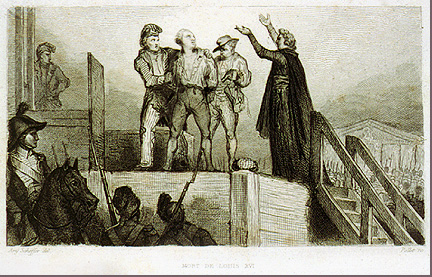
I set up this exercise using a source depicting Louis XVI’s execution. I was not able to determine the origin of this source. For the purpose of this assignment, I told students that we were going to assume it was created in 1830. Why did I have to give them a year? And why did I choose 1830? I knew that handing them a source and providing them with no information about who created it  and when undermined the sourcing that I was going to have them do. I chose 1830 because I wanted to force students to think about the distance between the execution of Louis and the (supposed) creation of this source. What impact did over  three decades have on how students interpreted this source?   Louis Execu.jpg


How did I set this up?
Here are some questions that I used in class.
What is a source? (Some points to make/questions to ask: Are all sources the same? Should we treat a letter from a soldier to his wife differently than we might treat a collection of receipts or government statistics? If so, why? What's the difference?  

Key point: A source is someone/something from which we get information. Students are often desensitized to the sources they  encounter regularly, especially textbooks and teachers. Student desensitization is evident when their default is to accept information on face value that is provided by teachers and textbooks.)
Why is it important to question a source?  (Some points to make/questions to ask:  And what do we even mean by questioning a source? When we question a source, what kinds of questions should we ask? Some expected student responses to the importance of questioning a source:
So you can decide whether or not to believe the information.
So you can evaluate how accurate the information is.
(What are some points that I ought to make at this point in the lesson? Or at some point in this lesson? A source can often tell us much more than it literally says. It can tell us about the time period being studied. We need to interrogate a source in order to arrive at some of the more subtle meanings and messages contained within a source. When we get information we need to think about how the messenger influences the message. Source work is conducted for a reason.  When historians are working with sources, whether primary or secondary, it is because they are trying to answer certain questions about the past.
How did I transition to the activity?
Tell students that sourcing is the first step in historical analysis, in thinking like an historian (see Big Six: 47).
Some sourcing questions are straightforward.
When was this source written/created?
Who created it?
What was the creator’s point of view? How do we know?
The Big Six text discusses how sourcing questions can become more subtle, abstract, and inference based. The big idea here, I think, is that we need to take what we have learned via our sourcing questions and draw some inferences, make some educated predictions about the reliability and usefulness of the source.
Based on our sourcing questions and answers, we to consider the creator of the source’s agenda: their purpose, goal(s) and motivations. And we need to keep these factors in mind when making judgments about the source.
For example, just because Napoleon says something happened, doesn’t mean that it happened exactly as he says. Napoleon’s words, though, do reveal aspects of his personality and character. They also tell us about his world, what was going on around him. For this reason, once we identify and account for a source's main biases, we can use the source to support our arguments about the past. 
How reliable is this source? It depends on the historical questions you are asking.
Questions of reliability need to be precisely stated. Reliability does not just exist out there, as a concept. Reliable how? If this source is being used to consider how artists at different moments in time have portrayed Louis’ execution, then this source is reliable, in as far as it tells us something about the time period when it was created. If this source is being considered as evidence of how Louis XVI acted in the moments leading up to his execution, then it may be less reliable, given (at least for the purpose of this assignment) that it was created thirty years after his execution.  
How did students interpret this source?
Some students were quick to describe the image, an essential beginning step in analyzing a source. It is necessary, however, that we teach students that they need to do more than just describe what they read or what they see. They need to link these observations to larger questions and answers. When students do this, they are beginning to think like an historian.
Here are some student comments that I’d like to consider (I have more that I will add and comment on) as I think about my rubric (linked below) and historical thinking in general:
Some student comments describing the image, describing Louis.
“Louis looks depressed.”
“..he must be scared. He is about to die. He acted calm and collected.”
“He listened to all of the orders he was given.” (We need to push the student to tell us why he is saying this. Is this accurate? We cannot determine the accuracy of this from a single source.)
“It is a picture of Louis getting executed.” (Though true, a basic observation.)

More comments will be added...
Additional Comments/Thoughts
-Some students may not even attempt to ‘close view/read’ the source. We should be able to discern whether or not a student has taken the time to view the source, to make some observations. Some students may 'close view' the source and see things that are not actually there. It is important that our rubric accounts for both possibilities.
Link to my Rubric ( I need to spend more time thinking about and writing about how I used this rubric and how it may need some revision.)

Saturday, February 22, 2014

Planning for Historical Thinking


Blog of Month February- Planning for Historical Thinking

Since the summer, I have spent many hours thinking about and discussing what I want to do more of in my history class. After thousands of tweets and many blog posts, now is the time for me to focus on specifics, to focus on what exactly I want to do in my classroom that is different from what I have done in the past. The History Blog Circle is an attempt to collaborate with others who are at various stages of a similar process, a process that at its core focuses on teaching students how to think like historians.

Starting last month and continuing indefinitely, I will continue to dig deeper as I explore what it means to think like an historian and how to set up a classroom that emphasizes this approach to teaching students about the past, present, and, I suppose, even the future.   

When I try to imagine change, I have found that sometimes it is helpful for me to start by defining what I don’t want to see. From there, I am often in a better position to conceptualize and articulate my vision, where I want to go and how I am going to get there. For the time being, that is going to be my approach with historical thinking. What are classrooms like where historical thinking is not occurring or only rarely occurs? And what can I do to avoid creating a classroom like this?

Students are quiet. Lots of teacher talk. 

I start with a basic assumption: When students are not writing or talking, I am severely limiting my opportunities to get them thinking about the past, to teach them specific historical thinking skills, and, in time, to assess their thinking, providing the feedback that is essential to help students become historical thinkers.

That is not to say that when I lecture students are not thinking. What, though, are they thinking about? I suspect that more often than not when we are talking, or ‘lecturing’, the chances that students are actually thinking about the topics we are discussing are often quite small.  If we cannot get students thinking aloud or on paper, then we cannot do much teaching. The best we can say that we are doing is talking; we are not teaching.

Assignments need to emphasize more than regurgitating content

Even a student with exceptional memory is not really learning much of value if all she can do is repeat what her teacher or her textbook says. As Grant Wiggins repeatedly reminds us, remembering is not understanding. Expecting and accepting recall of information as the main evidence of learning signals to students that the learning we value is primarily the learning associated with remembering, as opposed to understanding.

If superficial learning is the goal, then, indeed, little understanding is needed for students to demonstrate that they can remember content well enough to spit it back on a test. Knowing this, it is essential for me to consciously get students thinking on paper or out loud in class. Only then, can I push students to evaluate their thinking, the thinking of their classmates, their teacher, and all of the texts, written and unwritten, that we encounter in class.

Units and Lessons Need to Revolve around Questions

The Stanford Historical Education Group (SHEG) does this well. @William ABerry11 also discussed this in his post. I am still learning the best way to incorporate the SHEG model of lesson planning into my routine since the vast majority of the existing SHEG lessons do not connect to my Western Civ course.  When examining the SHEG lessons, you will notice that every lesson has a central question at the top the lesson plan. This approach, I think, is superior to structuring a lesson around a series of learning objectives, as many of us were taught in college when we first learned how to lesson plan.

I have noticed that the SHEG questions are usually fairly limited. They do not carry over into multiple lessons, the way that one of Grant Wiggins’ Essential Questions (EQs) does. I am also pretty sure that many of SHEGs questions revolve around why and how questions, as opposed to should or would questions.

As long as you are not attempting to build a lesson around a closed ended question, then this approach should work for you.  The bottom line here is that we set students up to construct a response to the lesson’s central question, requiring them to defend their position and support it with evidence derived from their analysis of primary and secondary sources.

How I have typically planned

Throughout my career, I have never planned my units and lessons in ways that are aligned with the best practices spelled out by Grant Wiggins and SHEG.

I like that Wiggins focuses on student understanding and transfer. He is eloquent in his articulation about why teaching discrete facts and isolated details is not meaningful. When I think about my history class, I have generally been content with teaching students information. When planning, I have typically started by making decisions about what I want to tell, or ‘teach’, students in class.

 In recent years, with the advent of department tests, my planning has revolved almost completely around the department tests. I have decided what to tell students by looking at the test. This is not what a good history teacher does. In fact, this is not what a good teacher does. What, then, do good history teachers do?

I have to decide what big ideas and essential understandings I am going to focus on in class.

I have been reading Grant Wiggins’ text Understanding by Design, where he discusses how teachers can teach students in a meaningful way, as opposed to providing them with superficial instruction that for all intents and purposes is a waste of time.

Wiggins emphasizes teaching for transfer, teaching students to use the concepts and skills they learn in your class in new and varied situations. Wiggins asserts, and I agree, that this type of deeper, lasting learning is not common.

Why? Wiggins premise is that it is not common because of how teachers teach. And, to tie these comments back to this month’s topic, how teachers teach is connected with how they plan their units and lessons.

If I am honest, I do not plan to teach for understanding, in the manner discussed by Wiggins. What do teachers who plan and teach using UbD principles do? What do they do that I do not do?

More to come…

Friday, January 24, 2014

Teaching facts about the past vs. teaching historical thinking


This is my first post in our monthly history blog circle. I have started the idea of a blog circle with the intention of creating a space for history teachers regularly to contribute blog posts about various curricular and instructional themes. Posts will be uploaded to this site on the last day of each month. Please let me know via a comment here or a message on Twitter if you would like to contribute a post. Suggested length for a contribution is 750-1250 words. That’s just a suggestion, though. Please don’t take these numbers too seriously.
Most of us have likely been in history classrooms where the transmission of factual information has been the main focus. As we all know, some teachers do this better than others. Well organized lectures, engaging videos, and interesting readings, by most measures, are the recipe for an ideal classroom experience. We ought to be doing more than this, though.  

This month’s posts focus on the following question: What’s the difference between teaching students facts vs. teaching them to think like an historian? Most of my time as a teacher, sorry to say, has focused more on teaching students to recall selected facts about the past rather than teaching them to use facts as they think critically about the past, present, and future. I am committed to changing this, and since early 2013, I have slowly been transforming my instructional approach.  
I am in the middle of my 13th year teaching social studies. And when I think back to my first attempts at teaching, I was like many new teachers, I suspect. As a new teacher, I taught the way that I had been taught, and the way that I saw my cooperating teacher teach.

And what was it that those who taught me did? What exactly was I imitating?
These teachers, many of whom I admired, told their students about the past. Most of them, I am pretty sure, often told me more than the textbook. This is what history teachers did, I thought. Good teachers went well beyond the text; mediocre teachers, less so.  And this is what I would end up doing once I entered the classroom. If I worked hard, I hoped, one day I would transition from a mediocre teacher to a good teacher.

With the exception of a single historiography course that I took in college, I learned a powerful lesson about teaching history. History teachers talked; and if they were good, they would talk about more than the textbook. And history students listened. And if they were good students, they would also take copious notes, recalling much of these notes from memory when assessed.  
As a teacher in training, I remember feeling a combination of awe and anxiety when I tried to imagine myself one day lecturing to my classes. Would I ever know as much as my professors, I wondered? I had a difficult time believing that one day I would be able to teach a forty minute or, even worse, a ninety minute class. How would I be able to talk that much? That was my focus when I thought about teaching.

Fast forward to 2013. When I look back on my teaching career, I am going to remember 2013 as the first school year that I was a connected educator. In the late spring and summer of 2013, I started to become more active on Twitter. Now, in January 2014, close to 10,000 tweets later, here I am. I am a co-founder and moderator of three active Twitter chats: #hsgovchat, #inquirychat, and #econchat. And, most importantly, each time I participate in one of these chats, or exchange ideas with other teachers, I am better for it. We learn and grow when we collaborate, question, and share. During my first twelve years of teaching, opportunities for collaboration and sharing were infrequent.  
Since having to draft my first philosophy of education in college, I have always had some constructivist ideas embedded in my thinking about teaching and learning. In practice, however, my actions have not been aligned with these views.  Since becoming more active on Twitter, and since being pushed to create common assessments with my colleagues, I have been forced to define what I really value as a social studies teacher. My tweets and my blog, I think, have captured my desire to become a better social studies teacher.

Returning to this month’s central question, what’s the difference between teaching students facts vs. teaching them to think like an historian? Put simply, I realize more than ever that critical thinking must encompass all that we do.
In classrooms where factual recall is the main emphasis, how well do students learn the skills associated with active, reflective citizenship? It is essential that we consider what we are trying to accomplish when we teach our students history.

Though it is not our only job, teaching students facts is not as simple as many make it out to be. We need to be thoughtful about the epistemological realities that exist when we choose which facts to teach our students. Who decides? The textbook publisher? Which facts are being left out of our  lessons? And why are they being left out?  And a ‘just the facts’ approach is not enough, is it? How could it be? After all, we need to teach students concepts, generalizations, and skills.
Critical thinking skills must be integrated into all that we do. And when we say critical thinking, we must be clear about what we mean by that term. Critical thinking is evaluative thinking. To evaluate means to make a judgment against some kind of criteria. What kind of judgments should students be making in our history classes? (maybe next month’s topic…?)

To help our students become better critical thinkers we must embed regular feedback procedures into our lessons. Teaching that doesn’t involve a series of feedback loops is not teaching; at best, it is talking, the spewing of content for students to regurgitate. This, to steal a term from Frank Nochese, is pseudoteaching.